
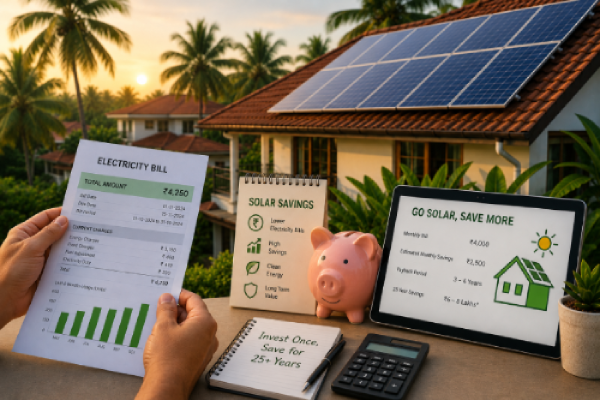
For most homeowners in Goa, the biggest question before installing rooftop solar is simple: “How many years will it take to recover my investment?” This is called the solar payback period. It tells you how long your solar savings will take to cover your installation cost.
In Goa, solar payback usually depends on your monthly electricity bill, system size, roof condition, subsidy eligibility, net metering, and installation quality. A home with a higher monthly bill will usually recover the investment faster than a home with very low usage.
Solar De Goa helps homeowners and businesses calculate this practically before installation. Instead of giving one fixed answer, Solar De Goa checks your electricity bill, roof space, usage pattern, and budget to estimate a realistic payback period.
If you are planning to install solar, Solar De Goa can help you calculate your expected payback period before you invest. Get a customized quote or schedule a site visit today.
What Is Solar Payback Period?
Solar payback period means the number of years it takes for your solar system to recover its cost through electricity bill savings.
For example, if your solar system costs ₹1,80,000 after subsidy and saves around ₹45,000 per year, your estimated payback period is around 4 years.
The formula is simple:
Payback Period = Net Solar Cost ÷ Annual Electricity Savings
But the real calculation should include more than just system price. It should also consider subsidy, monthly usage, roof suitability, net metering benefit, maintenance, and future electricity costs.
What Is a Realistic Payback Period in Goa?
For many residential solar users in Goa, a practical payback period may fall around 3 to 6 years, depending on system size and electricity usage. Homes with higher bills, good roof space, and subsidy eligibility may recover faster. Homes with lower bills or shade issues may take longer.
The Goa Solar Portal lists discovered residential rooftop solar rates in the range of ₹41–₹50 per watt, but the final project cost can vary based on components, structure, site conditions, meter work, and installer scope. The portal also shows that GEDA is the state nodal agency for rooftop solar subsidy implementation in Goa and that applications are processed through a single-window rooftop solar system.
This is why Solar De Goa recommends a proper site visit before giving a final ROI estimate.
How Monthly Bill Affects Payback
Your electricity bill is one of the strongest payback indicators.
If your monthly bill is around ₹2,000, solar may still help, but the recovery period can be slower. If your monthly bill is ₹4,000–₹7,000 or more, the payback can become much more attractive because your annual electricity expense is already high.
Here is a simple way to think about it:
If your current electricity bill is ₹4,000 per month, you are spending around ₹48,000 per year. If solar reduces a large portion of that bill, those yearly savings help recover your system cost.
Solar De Goa can study your last few electricity bills and estimate how much of your consumption can realistically be offset by rooftop solar.
Role of Subsidy in Payback
Subsidy can reduce the upfront investment and improve the payback period for eligible residential consumers.
Under PM Surya Ghar, listed subsidy amounts include ₹60,000 for 2–3 kW systems and ₹78,000 for systems above 3 kW, subject to scheme conditions and eligibility. MNRE also states that central financial assistance is available for residential consumers under the grid-connected rooftop solar programme, and subsidy is transferred after successful installation and verification through the applicable route.
This matters because a lower net investment means faster payback. For example, if two homes install similar systems but one receives subsidy and the other does not, the subsidized system will usually recover the investment sooner.
Net Metering and Savings
Net metering can also affect payback. When your solar system produces electricity during the day, your home uses that power first. If extra power is exported to the grid, it can help reduce your electricity bill as per applicable rules.
The Goa Solar Portal explains that empanelled vendors help with feasibility analysis and net meter application, and the installer coordinates installation, testing, commissioning, and post-commissioning obligations.
For homeowners, this means the right installer is important. A poor installation process can delay commissioning, while a clear process can help you start saving sooner.
Example: How Payback Might Work
Suppose a Goa homeowner has a monthly bill of around ₹4,500. That is ₹54,000 per year.
If rooftop solar reduces a strong portion of that bill, the homeowner may save a meaningful amount every year. If the final net investment after subsidy is recovered in 4 or 5 years, the system can continue delivering savings for many years after that.
This is not a promise of exact savings. Actual results depend on roof size, shade, system capacity, panel quality, inverter performance, and how much electricity the home uses during the day.
With Solar De Goa, the goal is to give realistic numbers, not inflated claims.
What Can Increase Payback Time?
Solar payback can take longer if your roof has heavy shade from trees or nearby buildings, your electricity bill is low, you install a system larger than your actual requirement, battery backup is added unnecessarily, the system uses poor-quality components, or net metering and commissioning are delayed.
This is why choosing the cheapest quote is not always the best decision. A transparent quote should explain system size, panel brand, inverter, structure, warranty, expected savings, and installation scope.
What Can Improve Payback?
Payback can improve when your bill is consistently high, your roof has good sunlight, system size matches actual usage, subsidy is available, installation is done correctly, net metering is handled properly, and the system is maintained well.
Solar De Goa helps homeowners and businesses in Goa choose the right system size instead of overspending on unnecessary capacity.
FAQ
What is a good solar payback period in Goa?
A practical payback period is often around 3 to 6 years, depending on cost, subsidy, usage, and roof conditions.
Does subsidy reduce payback time?
Yes. Subsidy reduces your net investment, which can shorten the time required to recover your money.
Can businesses also calculate payback?
Yes. Shops, offices, clinics, restaurants, and guest houses can calculate solar ROI based on monthly electricity savings and business usage patterns.
Is the cheapest solar quote best for faster payback?
Not always. A cheap system with poor components or weak service can reduce performance and hurt long-term savings.
Final Verdict
Solar payback in Goa depends on your bill, system cost, subsidy, roof quality, and installation process. For homes and businesses with regular electricity usage, solar can often recover its investment within a practical time frame and then continue reducing bills for years.
Get a customized solar quote from Solar De Goa and understand your expected payback period before you install.