
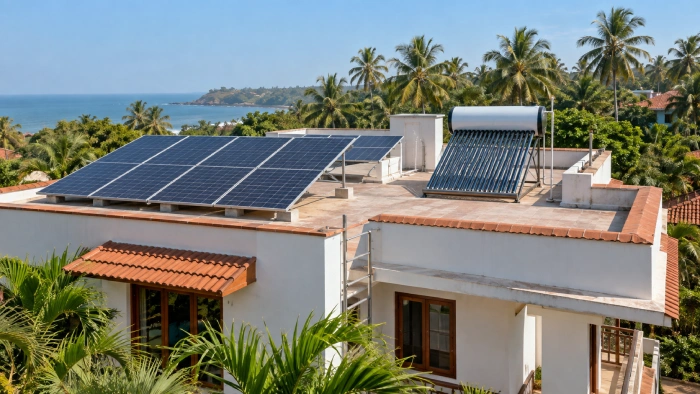
Many homes in Goa already use solar water heaters, especially where hot water demand is regular throughout the year. When the same homeowner later decides to install rooftop solar panels for electricity generation, an important planning question appears:
Can both systems share the same roof properly?
In many cases, yes. But the rooftop layout should be planned carefully.
A solar water heater and a rooftop solar PV system are different technologies. One is designed to heat water, while the other generates electricity. Both may need good access to sunlight, roof space, and maintenance areas, so poor placement can create unnecessary shade, blocked pathways, difficult servicing, or inefficient use of the roof.
Solar De Goa can inspect the existing solar water heater, pipes, roof area, access routes, and available sunlight before preparing the PV panel layout.
If your home already has a solar water heater, ask Solar De Goa to assess the whole roof before deciding how many PV panels can realistically be installed.
Direct Answer: Can Solar Panels Be Installed on a Roof with a Solar Water Heater?
Yes, often they can.
The key is to plan around the existing water-heating system rather than treating the roof as empty space.
The installer should consider:
- Water-heater collectors
- Storage tank location
- Hot and cold water pipes
- Shadows created by the tank or structure
- Existing roof supports
- Drainage
- Walking access
- Future maintenance
- Usable panel area
The best layout is the one that allows both systems to work and remain accessible.
Start by Mapping the Existing Water Heater
Before designing the PV system, inspect the solar water heater already on the roof.
Note:
- Where the collectors are located
- Where the storage tank sits
- How much roof area the system occupies
- The direction and tilt of the collectors
- Where pipes enter the building
- Whether any frame or tank casts a shadow
- How technicians currently access the system
This should be done before calculating the final PV capacity.
A roof may appear large in total area, but the usable solar area can be smaller once water heaters, tanks, parapets, staircases, pipes, vents, and access paths are considered.
Watch for Shade from the Water-Heater Tank
The storage tank of a solar water heater may sit higher than the roof surface.
Depending on where it is positioned, it can cast shade onto nearby areas at different times of the day.
This matters because PV panels should ideally be placed where avoidable shading is minimized.
The installer should therefore check:
- Tank height
- Collector height
- Distance between systems
- Sun direction through the day
- Seasonal changes in shadows
- Nearby water tanks or trees
Do not simply place PV panels in every open gap without checking how shade moves.
Solar De Goa can assess the current rooftop conditions and design the PV layout around existing equipment.
Pipes Need Space and Protection
Solar water heaters usually have pipes running between the collectors, storage tank, and the home below.
These pipes should remain visible and accessible enough for future inspection and repair.
PV panels should not be positioned in a way that:
- Traps pipes underneath inaccessible areas
- Blocks valve access
- Makes leakage difficult to inspect
- Forces technicians to remove panels for minor plumbing work
- Creates unsafe stepping routes
If old pipes already require repair or replacement, it may be practical to complete that work before the PV system is installed.
This reduces the chance of disturbing the solar panels later.
Leave Proper Maintenance Access
One of the most common rooftop-planning mistakes is maximizing panel count without considering how someone will move around the roof later.
Both systems may require servicing over their lifetime.
Access may be needed for:
- Cleaning
- Water-heater servicing
- Plumbing repairs
- Tank inspection
- Solar panel inspection
- Roof waterproofing
- Drain cleaning
- Electrical maintenance
A layout that uses every available square metre may look efficient on paper but become inconvenient in practice.
Useful access routes should be deliberately preserved.
Water Tanks and Other Rooftop Equipment Matter Too
A roof with a solar water heater often contains additional equipment such as:
- Water-storage tanks
- Pump connections
- Overflow pipes
- Vent pipes
- Dish antennas
- AC outdoor units
- Staircase headrooms
- Clothes-drying areas
All of these reduce or influence usable PV space.
The installer should look at the entire rooftop rather than only the area beside the solar water heater.
This also helps prevent a panel layout that blocks normal household use of the terrace.
Should the Solar Water Heater Be Moved?
Not automatically.
If the existing water heater is in a suitable location, working properly, and does not create major layout problems, there may be no reason to move it.
Relocation may only be worth considering if:
- The current location creates significant shading
- It blocks most of the usable roof
- Access is already poor
- Plumbing needs major changes
- The existing structure is damaged
- A different layout would clearly improve both systems
Any decision to relocate should consider plumbing, structural support, service access, and the cost of moving the existing system.
The goal should not be to move equipment unnecessarily just to fit more panels.
What Should Be Checked During the Site Visit?
| Area | What to Review |
| Solar water-heater collectors | Position, tilt, condition and space occupied |
| Storage tank | Height, shade and structural location |
| Pipes | Route, condition and future access |
| PV panel area | Clear roof space and shading |
| Water tanks | Access and shadows |
| Roof obstacles | Vents, parapets, AC units and structures |
| Walking routes | Maintenance and cleaning access |
| Drainage | Keep outlets and channels accessible |
| Future work | Roof repairs, plumbing and equipment servicing |
A good rooftop plan should balance solar generation with long-term practicality.
Example: A Typical Goa Home
Imagine a two-storey home with a solar water heater on one side of the terrace and a water tank near the staircase.
There may still be enough roof area for a useful PV system.
But if the panels are placed too close to the water-heater tank, part of the array may experience avoidable shade. If panels are placed directly over pipe routes, future plumbing work may become difficult.
A better design may use slightly less roof area while maintaining clear access between the water heater, tank, pipes, drains, and PV panels.
That can make the rooftop easier to maintain over time.
Common Mistakes to Avoid
Do not treat the roof as empty simply because there is visible open space.
Do not block access to the solar water heater.
Do not install panels over plumbing points that may need regular service.
Do not ignore shadows from tanks and raised structures.
Do not place panels so close to roof drains or water tanks that routine maintenance becomes difficult.
And do not assume the existing water heater needs to be removed just because rooftop solar is being added.
FAQ
Can I keep my solar water heater and also install solar panels?
Yes, often both systems can share the same roof if the layout, shade, access, and available space are planned properly.
Will the solar water-heater tank shade PV panels?
It can, depending on its height and position. The installer should assess shade before finalizing the panel layout.
Should old solar water-heater pipes be repaired before PV installation?
If pipes are leaking, damaged, or likely to need replacement soon, completing that work first may make future maintenance easier.
Do solar panels need space around the water heater?
Enough access should be retained so the water heater, pipes, and PV system can all be inspected and serviced.
Can Solar De Goa plan both systems on the same roof?
Solar De Goa can inspect the existing water heater, roof space, obstacles, shade, and access before designing the rooftop PV layout.
Final Verdict
An existing solar water heater does not automatically prevent a Goa home from installing rooftop solar panels.
The key is thoughtful rooftop planning.
Collectors, storage tanks, pipes, shade, drainage, water tanks, and maintenance routes should all be mapped before the PV system is finalized.
A well-planned layout allows both systems to coexist without creating unnecessary maintenance problems or wasting useful roof space.
Schedule a rooftop solar assessment in Goa with Solar De Goa and plan your new solar PV system around the equipment and usable space already available on your roof.