
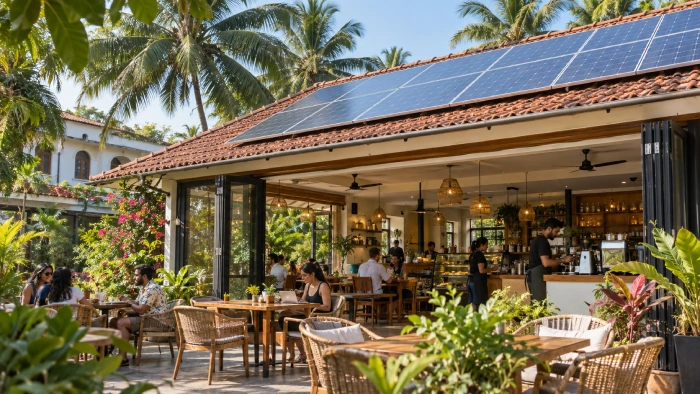
Restaurants and cafés in Goa can have very different electricity needs from ordinary shops. Refrigerators may run throughout the day, air conditioners keep dining areas comfortable, exhaust and ventilation systems support kitchen operations, and lighting, billing counters, coffee machines, freezers, water pumps, and food-preparation equipment may all add to the monthly electricity bill.
Because many of these loads operate during daylight hours, rooftop solar can be worth evaluating as a way to reduce dependence on grid electricity.
However, restaurant solar should not be planned simply by looking at the total monthly bill. The installer should understand when electricity is being used, which equipment runs during the day, how much roof space is available, and whether the business also has heavy evening or night-time demand.
Solar De Goa helps restaurants, cafés, and other commercial properties review electricity usage, roof conditions, operating hours, and system requirements before recommending a commercial solar setup.
If you run a restaurant or café in Goa, Solar De Goa can review your electricity bills and daytime operating pattern to help you understand whether rooftop solar is practical for your business.
Direct Answer: Is Solar Useful for Restaurants and Cafés?
Yes, rooftop solar can be useful for restaurants and cafés with regular daytime electricity consumption and suitable roof space.
Solar generation during the day may support part of the electricity being used by refrigeration, AC, lighting, kitchen equipment, billing systems, ventilation, and other active loads.
The actual financial value depends on electricity consumption, operating hours, roof conditions, system size, equipment usage, and the applicable billing arrangement.
This is why a commercial solar assessment should look at both the bill and the restaurant’s daily operating pattern.
Kitchen Equipment Creates a Different Load Profile
Restaurants use electricity in ways that are very different from homes or standard retail shops.
Depending on the business, kitchen-related electrical loads may include:
- Refrigerators
- Deep freezers
- Cold-storage cabinets
- Mixers and grinders
- Food processors
- Microwave ovens
- Electric cooking equipment
- Coffee machines
- Dishwashers
- Exhaust systems
- Ventilation fans
Not every restaurant uses the same equipment. Some kitchens rely heavily on gas for cooking while still using significant electricity for refrigeration, AC, preparation equipment, and ventilation.
A solar proposal should therefore be based on the actual appliances and electricity bills rather than assumptions about the type of restaurant.
Refrigeration Often Runs for Long Hours
Refrigeration is one of the most important loads in many food businesses.
Restaurants may need to keep vegetables, dairy products, beverages, frozen foods, meat, seafood, desserts, and prepared ingredients at appropriate temperatures throughout the day and often after the restaurant closes.
This creates two different planning questions:
- How much refrigeration demand occurs while solar panels are generating power?
- How much electricity is still required after sunset?
A standard grid-connected solar system can help reduce daytime grid consumption, but refrigeration that continues overnight will still need electricity when solar generation is unavailable.
This distinction should be understood before calculating expected savings.
Air Conditioning Can Add Significant Daytime Demand
Many Goa restaurants and cafés use air conditioning for customer comfort, particularly during hot and humid periods.
If the dining area is open during lunch and afternoon hours, AC use may overlap well with solar-generation periods. Lighting, billing counters, refrigerators, kitchen equipment, and ventilation may also be operating at the same time.
This combined daytime demand can make commercial solar worth investigating.
Solar De Goa can review the restaurant’s electricity bills and operating schedule to identify whether the business has a strong daytime solar-use pattern.
Lunch Businesses and Dinner Businesses May Differ
Operating hours matter.
A café that opens early in the morning and remains busy through the afternoon may have a different solar opportunity from a restaurant that receives most customers after sunset.
Similarly, a beach café, bakery café, quick-service restaurant, fine-dining venue, or takeaway outlet may all have different usage patterns.
For example, a lunch-focused restaurant may use refrigeration, AC, exhaust, lights, and preparation equipment heavily during daylight hours. A dinner-heavy restaurant may still benefit from daytime food preparation and refrigeration, but a greater portion of its customer-service electricity demand may occur at night.
That is why solar ROI should be assessed from usage timing, not only the total bill.
Roof Space and Restaurant Location
Restaurants in Goa operate from many property types:
- Independent buildings
- Commercial complexes
- Hotels
- Rented shops
- Heritage structures
- Beach-area properties
- Mixed-use buildings
- Mall or market units
Before planning rooftop solar, check:
- Who owns the roof?
- Does the restaurant have roof rights?
- Is landlord permission needed?
- Is there enough usable roof space?
- Are water tanks or kitchen exhaust equipment occupying the roof?
- Does nearby vegetation or construction create shade?
- Where can the inverter be installed?
- Is there safe access for future service?
The rooftop may be large, but kitchen ducts, tanks, pipes, and other equipment can reduce usable panel space.
What Affects Solar Savings for a Restaurant?
| Factor | Why It Matters |
| Monthly electricity use | Shows overall business consumption |
| Daytime operating hours | Determines how much demand overlaps with solar generation |
| Refrigeration | Often creates a steady electrical load |
| Air conditioning | Can significantly increase daytime usage |
| Kitchen equipment | Changes the restaurant’s load profile |
| Roof space | Limits practical solar capacity |
| Shade | Can affect available generation |
| Property ownership | Determines whether installation permission is available |
| System size | Must match the site and usage pattern |
Savings should be calculated for the individual business rather than promised as a fixed percentage.
Common Mistakes Restaurant Owners Should Avoid
Do not assume that a high electricity bill automatically means a very large solar system is required.
Do not size the system only from kitchen-equipment ratings without reviewing electricity bills and operating hours.
Do not assume solar will completely eliminate the restaurant’s electricity bill, especially when the business has substantial night-time demand.
If the property is rented, do not invest without confirming roof permission, lease conditions, and who will own the system.
Also, avoid choosing a commercial proposal only because it has the lowest price. The quote should clearly cover panels, inverter, structure, wiring, installation, safety components, and service support.
Questions to Ask Before Installing Solar
Before approving a commercial solar proposal, ask:
- How much electricity does the restaurant use each month?
- What portion of usage occurs during daylight?
- How much power is used by AC and refrigeration?
- Is the rooftop suitable for solar?
- Is roof permission clear?
- What system size is being recommended and why?
- What is included in the quotation?
- How will future kitchen or AC expansion affect usage?
- What monitoring and service support is available?
These questions help turn solar into a business decision rather than simply an equipment purchase.
FAQ
Is rooftop solar suitable for restaurants in Goa?
It can be suitable when the restaurant has meaningful daytime electricity consumption, usable roof space, and a practical installation location.
Can solar support restaurant refrigeration?
Solar generation can contribute to the restaurant’s combined daytime electricity demand, including refrigeration. The actual contribution depends on system size and consumption.
Can solar reduce restaurant AC costs?
It may help reduce daytime grid consumption when AC use overlaps with solar-generation hours.
Will solar eliminate the restaurant’s full electricity bill?
Not necessarily. Restaurants may continue using grid electricity at night or whenever demand exceeds solar generation.
Can Solar De Goa assess a café or restaurant?
Yes. Solar De Goa can review electricity bills, operating hours, roof space, and equipment usage before recommending a commercial solar system.
Final Verdict
Restaurants and cafés in Goa can be strong candidates for rooftop solar when refrigeration, AC, kitchen equipment, ventilation, lighting and other loads create regular daytime electricity demand. The right system should be planned around actual bills, operating hours, equipment usage and available rooftop space.
Request a commercial solar assessment in Goa from Solar De Goa and understand how rooftop solar could reduce grid electricity use for your restaurant or café.