
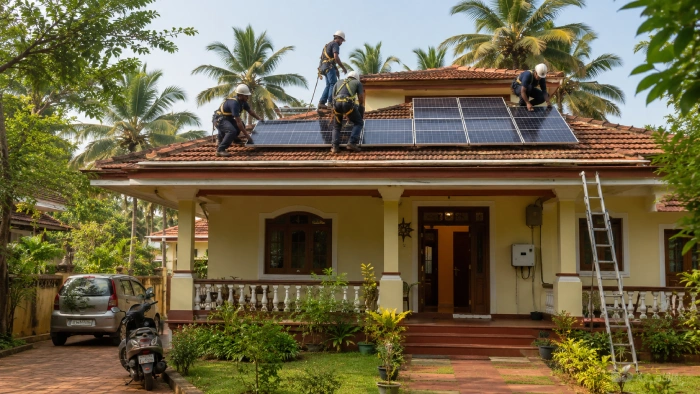
Many homeowners in Goa want to install rooftop solar but delay the decision because they worry about disturbance. They imagine drilling noise, workers moving through the house, wiring mess, roof access issues, dust, and disruption to daily routines. These concerns are normal, especially when the home is already occupied by families, children, elderly parents, tenants, or work-from-home professionals.
The good news is that solar installation in an occupied home can be planned smoothly when the site is inspected properly and the installation steps are explained in advance. Solar De Goa helps homeowners plan rooftop solar with practical attention to roof access, inverter placement, wiring route, safety, and household convenience.
If you are living in the home where you want to install solar, Solar De Goa can inspect your rooftop, explain the installation process, and plan the work in a way that reduces unnecessary disturbance.
Direct Answer: Can Solar Be Installed in a Home While People Are Living There?
Yes, solar can be installed in an occupied home. In most cases, homeowners do not need to move out or stop daily life completely. However, the installer should plan roof access, material movement, wiring, inverter location, and work timing before installation begins.
To understand every stage of the project before work begins, read our guide on the solar installation process in Goa and see what happens from site inspection to final commissioning.
Read our guide on the solar installation process in Goa
Why Occupied Homes Need Better Planning
An empty or newly built house gives installers more flexibility. But an occupied home has routines. People may be cooking, working, studying, resting, using the terrace, drying clothes, or moving around the house during installation.
This is why the solar company should not arrive and decide everything on the spot. A proper site visit should identify where workers will enter, how panels will be moved, where tools will be kept, where wiring will pass, and what areas should be protected.
Solar De Goa helps homeowners understand these details before work starts, so installation feels organized instead of stressful.
Roof Access Is the First Thing to Check
The roof is the main work area during solar installation. If the home has a clear staircase and safe access, the process is usually easier. If access is narrow, shared, tiled, sloped, or difficult, the team may need extra planning.
Before installation, ask how panels, mounting structures, tools, and wiring materials will be taken to the roof. Also ask whether any furniture, plants, clotheslines, water tanks, or storage items need to be moved temporarily.
Good roof access planning helps avoid confusion on installation day.
Wiring Route Should Be Decided Early
Wiring is one of the biggest concerns for homeowners. Nobody wants exposed cables running randomly across walls or roof areas. The wiring route should be discussed before the work begins.
The installer should explain how cables will run from the solar panels to the inverter and from the inverter to the electrical system. If conduits, drilling, wall entry points, or roof entry points are needed, these should be planned clearly.
Solar De Goa can help homeowners choose a practical wiring route that keeps the setup clean, safe, and serviceable.
Inverter Placement Should Not Be Random
The inverter should be placed in a safe, accessible, and ventilated location. In an occupied home, it should also be placed where it does not disturb daily movement.
Avoid damp corners, spaces exposed to rain, areas blocked by furniture, or places where children can easily interfere with the equipment. A utility wall, covered service area, garage, passage wall, or suitable electrical zone may work better, depending on the house layout.
The inverter location should be finalized before installation so wiring can be planned neatly.
How to Reduce Daily Disturbance During Installation
A good installation plan should answer simple household questions: When will the team arrive? Which areas will they use? Will power need to be switched off for any stage? How much drilling is expected? Will roof access be blocked? How will cleanup be handled?
Homeowners can reduce disturbance by keeping roof access clear, informing family members about the work schedule, keeping pets away from work areas, moving fragile items if needed, and confirming the expected work sequence with the installer.
This does not mean the home will face major disruption. It simply means small planning steps make the experience easier.
Occupied Home Solar Installation Checklist
| What to Plan | Why It Matters |
| Roof access | Helps workers move panels and tools safely |
| Material movement | Avoids confusion inside the home |
| Wiring route | Keeps the installation neat and practical |
| Inverter location | Supports safety, ventilation, and service access |
| Drilling points | Helps homeowners prepare for noise and wall work |
| Work timing | Reduces disturbance for family members |
| Safety areas | Keeps children, pets, and residents away from work zones |
| Cleanup | Ensures the home is left usable after installation |
What About Elderly Family Members or Work-from-Home Users?
If elderly family members live in the home, installation timing should be planned carefully. Avoid unnecessary disturbance near bedrooms, resting areas, or common movement paths.
For work-from-home users, discuss whether internet, power, or access may be affected during any stage. Most installation work happens on the roof, but some electrical connection work may need coordination.
A professional installer should explain this before work starts.
Common Mistakes to Avoid
Do not finalize installation without a site visit. Do not ignore wiring routes. Do not assume the inverter can be placed anywhere. Do not wait until installation day to clear the roof. Do not choose a quote only because it is cheap if the installer has not explained how the work will be done.
A smoother installation depends on planning, not just panel quality.
FAQ
Can solar be installed while my family is living in the house?
Yes. Solar can usually be installed in occupied homes with proper planning and safe roof access.
Will solar installation create a lot of mess?
It does not have to. A clean installation plan should include wiring route, material movement, drilling points, and cleanup.
Will power be switched off during installation?
There may be stages where electrical work needs coordination. Your installer should explain this before work begins.
Do I need to clear my roof before installation?
Yes, it is helpful to clear clotheslines, stored items, plants, or obstacles from the planned work area.
Can Solar De Goa plan installation for occupied homes?
Yes. Solar De Goa can inspect your home and plan roof access, inverter placement, wiring route, and installation flow.
Final Verdict
Solar installation in an occupied home in Goa can be managed smoothly when the process is planned before work begins. The key areas to check are roof access, wiring route, inverter Solar De Goa helps homeowners plan rooftop solar installation in a practical way, so the system can be installed with less confusion and better coordination.
Book a solar site inspection in Goa with Solar De Goa and plan a clean, practical solar installation for your occupied home.