
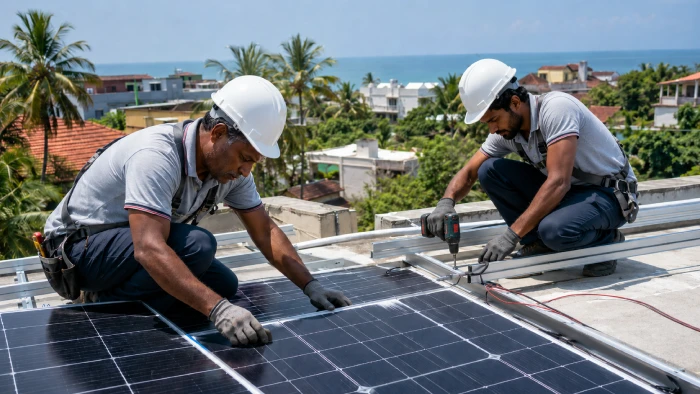
Installing rooftop solar in Goa is not just about placing panels on your roof. A proper solar installation includes site inspection, system sizing, quotation, documentation, approvals, installation, testing, net metering, and final commissioning. When each step is handled properly, the system performs better and the homeowner gets more confidence in the investment.
Solar De Goa helps homeowners and businesses in Goa move through this process with practical guidance, from checking roof suitability to planning the right solar system and completing installation support.
If you are planning to switch to solar, Solar De Goa can inspect your site, estimate your savings, and explain the full installation process before you invest. Schedule a site visit or get a customized solar quote today.
Direct Answer: What Is the Solar Installation Process in Goa?
The solar installation process usually starts with a site visit and ends with final commissioning. The major steps are:
- Electricity bill review
- Roof inspection
- Solar system design
- Quotation and cost approval
- Documentation and application support
- Material delivery
- Panel and inverter installation
- Testing and safety checks
- Net meter coordination
- Final commissioning and handover
The Goa Solar Portal also describes installer responsibilities such as application support, roof feasibility analysis, installation as per GEDA specifications, testing and commissioning, signing the joint inspection report, and operation and maintenance after commissioning.
Step 1: Electricity Bill Review
The first step is understanding your electricity usage. A good solar installer will not recommend a system only by looking at roof size. Your monthly bill, unit consumption, sanctioned load, usage pattern, and future needs should be reviewed.
For example, a family using ACs, water pumps, washing machines, and home office equipment may need a different system from a small household with limited daytime usage. Solar De Goa uses this stage to understand whether solar is financially practical and what kind of savings the customer can expect.
Step 2: Roof Inspection and Feasibility Check
After reviewing the bill, the roof needs to be inspected. This includes checking roof space, direction, slope, shade, access, and structural condition. The Goa Solar Portal’s application guidance also tells users to assess roof suitability by considering factors such as roof size, orientation, shading, and slope.
In Goa, this step is especially important because many homes have coconut trees, water tanks, tiled roofs, sloping roofs, or nearby buildings that may create shade. Even a good solar system can underperform if the roof is not suitable.
Step 3: System Size Recommendation
Once the roof and bill are checked, the installer can recommend the right solar system size. This should not be guessed. The system should match your electricity usage and available roof area.
If the system is too small, your savings may be limited. If it is too large, your investment may be higher than needed. Solar De Goa focuses on customized solar solutions so customers do not overspend on unnecessary capacity.
Step 4: Quotation and Cost Clarity
A solar quotation should clearly explain what is included. It should mention panels, inverter, mounting structure, wiring, safety components, installation, warranty, and service support.
This stage is where many homeowners make mistakes. They compare only the final price and ignore what is included or excluded. A transparent quote helps you understand real cost, expected savings, and likely return on investment.
With Solar De Goa, customers can ask practical questions before finalizing: What brand of panels are used? What inverter is included? Is net metering support included? What warranties apply? Are there any extra charges?
Step 5: Documentation and Application Support
After the quote is approved, documentation and application work begins. This may involve customer documents, electricity connection details, system details, and application submission.
The Goa Solar Portal lists a unified process for rooftop solar and mentions installer support for application submission and feasibility analysis. The portal also lists important documents related to grid-connected rooftop solar with net, group net, and virtual net metering for FY 2023–2026.
For homeowners, the main point is simple: choose an installer who can guide you through the paperwork instead of leaving you confused after payment.
Step 6: Material Delivery and Installation
Once documentation and planning are ready, materials are delivered to the site. Installation usually includes mounting structure fixing, panel placement, inverter installation, wiring, earthing, and safety connection work.
This is where workmanship matters. Poor alignment, weak structure, loose wiring, or bad cable management can affect performance and safety. Solar De Goa provides installation support for both residential and commercial projects, helping customers move from planning to execution with clarity.
Step 7: Testing and Safety Checks
After installation, the system should be tested before final handover. Testing checks whether the panels, inverter, wiring, earthing, and generation are working properly.
The Goa Solar Portal specifically mentions testing and commissioning of the solar rooftop plant as part of installer responsibilities. This step should never be rushed because it confirms whether the system is ready for long-term use.
Step 8: Net Metering and Final Commissioning
Net metering is an important part of grid-connected rooftop solar. It helps adjust exported solar generation against your electricity bill as per applicable rules. Final commissioning confirms that the system is officially ready and connected properly.
The installer’s role may include coordination, inspection support, signing the joint inspection report, and commissioning-related steps. Once commissioning is complete, the customer should receive basic guidance on monitoring, cleaning, maintenance, and whom to contact for service.
Common Questions Before Installation
How long does solar installation take?
The physical installation may be completed faster than the full process, but approvals, inspection, net metering, and commissioning can take additional time.
Do I need to repair my roof first?
If the roof has leakage, cracks, weak areas, or access issues, repairs should be handled before installation.
Will solar work on a shaded roof?
Partial shade may reduce generation. A site visit is needed before giving a final answer.
Should I choose the cheapest installer?
Not always. Installation quality, warranty, documentation support, and service matter for long-term savings.
Final Verdict
The solar installation process in Goa becomes much easier when you know the steps in advance. A proper process starts with your electricity bill, moves through roof inspection and system design, and ends with testing, net metering, commissioning, and handover.
Solar De Goa helps homeowners and businesses in Goa make this process practical with site inspection, cost estimation, customized solar solutions, and reliable installation support.
Book a solar site visit with Solar De Goa and get a clear installation roadmap before you invest.