
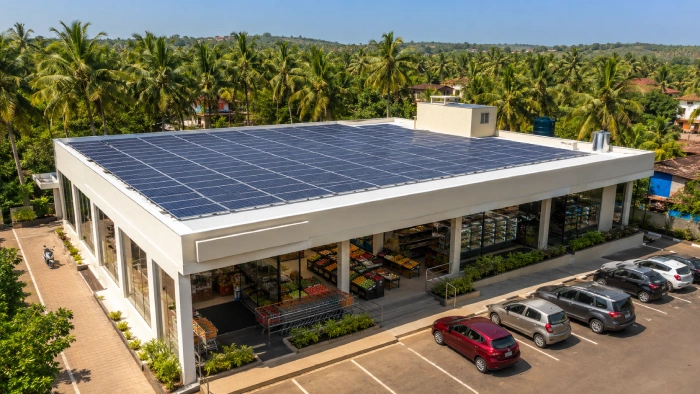
Supermarkets and grocery stores in Goa often have steady electricity usage throughout the day. Refrigerators, deep freezers, display coolers, lighting, billing counters, fans, ACs, weighing machines, CCTV, and office equipment can all add to the monthly power bill. For many store owners, electricity is not a small expense. It is part of the regular operating cost of running the business.
This is where rooftop solar can become a practical business decision. Solar does not remove every cost automatically, but it can help reduce dependence on grid electricity when the system is planned correctly.
Solar De Goa helps business owners in Goa evaluate solar based on actual electricity usage, roof space, daytime load, system size, and expected savings. Instead of giving a generic solar recommendation, Solar De Goa can help supermarkets and grocery stores understand whether solar fits their daily power needs.
If you run a supermarket or grocery store in Goa, Solar De Goa can review your electricity bills, inspect your rooftop, and suggest a solar setup based on your business usage. Get a customized commercial solar assessment before you decide.
Direct Answer: Is Solar Useful for Supermarkets and Grocery Stores?
Yes, solar can be useful for supermarkets and grocery stores because these businesses often use electricity during the day, when solar panels are generating power. Refrigeration, lighting, ACs, billing systems, and daily store operations can make solar financially relevant.
The final savings depend on electricity usage, roof space, system size, installation quality, operating hours, and billing rules. A site inspection and bill review are important before finalizing the system.
Before selecting a system, it also helps to understand how a commercial solar installation in Goa is planned for business properties with consistent daytime electricity usage. This gives store owners a clearer idea of system sizing, installation planning, and long-term operating cost reduction.
Read our guide on commercial solar installation in Goa.
Why Grocery Stores Have Strong Solar Potential
A grocery store may look simple from the outside, but its electricity use can be steady. Refrigerators and freezers often run for long hours. Lights stay on during business hours. Billing counters, fans, CCTV, and small office equipment also add to the total load.
Supermarkets may have even higher usage because they may include multiple display coolers, freezer sections, air conditioning, storage rooms, and longer working hours.
Because many of these loads run during daylight hours, solar can support a portion of the store’s daytime electricity requirement. That makes this topic different from homes that use most electricity only at night.
Refrigeration Is the Main Power Concern
For many grocery stores and supermarkets, refrigeration is one of the most important electricity loads. Freezers and coolers cannot simply be switched off to save power. They must run to protect stock quality.
Solar can help reduce the grid power used during the day, but the system must be planned carefully. The installer should understand how many freezers, display coolers, and refrigerators are running, how many hours the store operates, and whether the rooftop has enough usable space.
Solar De Goa can help store owners evaluate this practically before choosing a system size.
Lighting, AC, and Billing Loads Also Matter
Even if refrigeration is the biggest concern, it is not the only load. Many supermarkets use bright indoor lighting, outdoor signage, fans, ACs, CCTV, billing counters, barcode systems, and computers.
These loads may not seem large individually, but together they contribute to the monthly bill. A solar assessment should look at the full store operation, not only one appliance type.
For example, a small grocery store with a few refrigerators may need a different system from a larger supermarket with ACs, cold storage sections, and multiple billing counters.
Roof Space and Store Location
The right solar system depends on roof availability. Some grocery stores operate from standalone buildings with usable rooftops. Others operate in rented commercial spaces or shared buildings where roof permission may be needed.
Before planning solar, store owners should check:
- Is the roof owned, rented, or shared?
- Is there enough clear space?
- Is the roof shaded by nearby buildings or trees?
- Can panels be accessed for cleaning and maintenance?
- Where will the inverter be placed?
- Is the wiring route practical?
A site inspection helps answer these questions before a quote is finalized.
How Solar Can Improve Business ROI
For supermarkets and grocery stores, solar should be viewed as an operating-cost decision. The goal is to reduce monthly electricity burden and improve long-term business value.
If a store has regular daytime usage and suitable roof space, solar may improve the business case by reducing grid consumption over time. But the exact ROI should not be guessed. It should be estimated based on actual electricity bills and system design.
Solar De Goa helps business owners understand solar savings, payback thinking, and system planning without overpromising fixed results.
Common Mistakes Store Owners Should Avoid
The first mistake is choosing solar only by lowest price. A commercial solar system should be planned around load, roof space, structure, inverter, wiring, safety, and service.
The second mistake is ignoring refrigeration load. If the installer does not understand your cooling equipment, the system recommendation may not match your business needs.
The third mistake is assuming solar will remove the full electricity bill. Solar can reduce dependence on grid power, but savings depend on usage and system performance.
The fourth mistake is not checking roof permission. If the store is rented, confirm roof access and approval before planning installation.
Questions to Ask Before Installing Solar
| Question | Why It Matters |
| How much electricity does my store use monthly? | Helps estimate system requirement. |
| How many refrigerators and freezers run daily? | Refrigeration affects load planning. |
| Do I use more power during the day? | Daytime usage improves solar relevance. |
| Is my roof suitable? | Space, shade, and access affect output. |
| Is the quote designed for commercial usage? | Business loads differ from home loads. |
| What service support is available? | Commercial systems need reliable support. |
FAQ
Is solar worth it for grocery stores in Goa?
It can be worth evaluating if the store has regular electricity usage, daytime operations, and usable roof space.
Can solar support refrigerators and freezers?
Solar generation can support daytime electricity loads, including refrigeration, depending on system size and actual usage.
Will solar remove my store’s full electricity bill?
Not necessarily. Solar can reduce grid dependence, but savings vary by system design, usage, roof space, and billing rules.
Can a rented grocery store install solar?
Possibly, but roof permission, lease terms, and ownership approval should be checked first.
Can Solar De Goa assess a supermarket or grocery store?
Yes. Solar De Goa can review electricity bills, inspect the rooftop, and recommend a commercial solar setup based on store usage.
Final Verdict
Supermarkets and grocery stores in Goa can be strong candidates for solar because refrigeration, lighting, ACs, billing counters, and daily operations often create steady daytime power usage. But the system must be planned around actual business loads, not a generic package.
Solar De Goa helps store owners evaluate solar through bill review, rooftop inspection, system sizing, and practical commercial solar guidance.
Get a customized commercial solar assessment from Solar De Goa and understand how solar can reduce electricity costs for your supermarket or grocery store.