
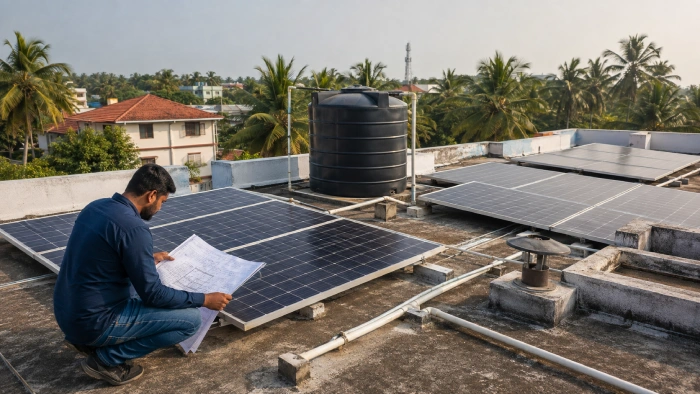
Many rooftops in Goa are not completely empty. They may have water tanks, plumbing pipes, solar water heaters, dish antennas, clotheslines, parapet walls, stairway cabins, stored items, or shaded areas created by nearby trees and buildings.
These obstacles do not automatically make the roof unsuitable for solar. However, they can affect how many panels fit, where the panels are placed, how workers access the system, and how the final installation quote is prepared.
This is why rooftop solar should not be quoted only from the total roof size or a few photographs. The usable roof area must be checked through proper layout planning.
Solar De Goa helps homeowners and businesses inspect rooftop obstacles, identify practical panel zones, plan access routes, and prepare a solar proposal based on the actual property.
If your roof contains water tanks, pipes, antennas, or limited open space, schedule a Solar De Goa site inspection before choosing the system size or approving a quote.
Direct Answer: Can Solar Be Installed Around Roof Obstacles?
Yes, solar can often be installed on roofs with water tanks, pipes, parapet walls, and other obstacles. The installer must identify usable areas, possible shade, access paths, wiring routes, mounting locations, and space needed for future maintenance.
The system should be designed around the roof rather than forcing a standard panel arrangement onto the property.
Total Roof Area Is Not the Same as Usable Roof Area
A homeowner may know the total roof dimensions, but not all of that space will necessarily be available for solar panels.
Some areas may be occupied by:
- Water tanks
- Plumbing and drainage pipes
- Solar water heaters
- Staircase structures
- Parapet walls
- Dish antennas
- Clothes-drying areas
- Roof access doors
- Ventilation outlets
- Existing electrical equipment
- Permanent shade
- Areas needed for walking and maintenance
The installer must separate the total roof area from the area that can practically support panels.
A smaller, clear, well-planned area may be more useful than a larger roof filled with obstacles and shade.
Water Tanks Can Affect Panel Placement
Water tanks are common on Goa rooftops. Depending on their height and location, they may create shade during part of the day or block a potential panel row.
The installer should check:
- The tank’s location and height
- The direction and timing of its shadow
- Space required for tank cleaning or repair
- Access to inlet, outlet, and overflow pipes
- Whether the tank may be replaced or expanded later
- Whether panels would restrict plumbing work
Panels should not be placed in a way that makes future tank maintenance unnecessarily difficult.
Moving a tank may sometimes be discussed, but it should not be assumed. Relocation can involve plumbing changes, structural considerations, and extra cost. In many cases, the better option is to design the solar layout around the existing tank.
Pipes and Drainage Routes Must Remain Accessible
Rooftop plumbing may include water lines, overflow pipes, rainwater outlets, drainage channels, or pipes connected to solar water heaters.
These routes should be identified before mounting structures are fixed. Panels and supports should not block important drainage areas or make pipe repair difficult.
This is especially relevant during Goa’s monsoon. Roof water should continue to drain properly, and installers should avoid creating unnecessary obstructions around outlets and channels.
A proper site inspection allows the installer to plan panel rows while preserving practical access to plumbing and drainage.
Shade Is More Important Than the Obstacle’s Size
A small rooftop object can sometimes create a larger planning issue if it casts shade across panels during important generation hours.
Possible shade sources include:
- Water tanks
- Staircase cabins
- Parapet walls
- Coconut trees
- Nearby buildings
- Antennas
- Utility structures
Shade may change across the day and across different seasons. This is why layout planning should not be based only on how the roof looks at one moment.
Solar De Goa can assess the property and recommend a layout that uses the clearer portions of the roof instead of simply filling every available gap.
Keep a Safe and Practical Access Path
Panels should not cover the entire roof without leaving space for movement. Homeowners may still need access for:
- Water tank cleaning
- Plumbing repairs
- Roof waterproofing
- Panel cleaning
- Electrical inspection
- Inverter or cable servicing
- Future building maintenance
A practical walkway makes service work easier and reduces the chance of someone stepping on panels or cables.
The panel layout should therefore balance capacity with accessibility. Fitting the maximum possible number of panels is not always the best long-term design.
Plan the Wiring Route with the Layout
Roof obstacles also affect how solar cables travel from the panels to the inverter.
The installer should identify a route that is protected, practical, and accessible for future inspection. Random cable paths around tanks, pipes, and roof edges can make the installation look untidy and complicate maintenance.
The wiring plan should consider:
- Distance from panels to inverter
- Safe cable support
- Roof entry points
- Existing electrical conduits
- Exposure to rain and movement
- Access for future servicing
Wiring and panel layout are only part of the overall project. Understanding the complete solar installation process in Goa can help you prepare for site inspection, system planning, installation, electrical work, and commissioning.
How Roof Obstacles Can Affect the Quote
| Layout Factor | Possible Effect on the Proposal |
| Reduced usable roof area | May limit the practical system capacity |
| Complex panel arrangement | May require additional design planning |
| Tank or wall shade | May change panel location |
| Difficult access | Can affect labour and material movement |
| Longer wiring route | May change installation scope |
| Raised mounting requirement | Can affect structure planning |
| Obstacle relocation | May involve separate work and cost |
| Maintenance walkways | May reduce the number of panels that fit |
The installer should explain which factors are included in the quotation and whether any additional preparation is required.
Should You Move Roof Obstacles Before Solar?
Not necessarily. Homeowners should not relocate tanks, pipes, or equipment before receiving professional layout advice.
Some obstacles can be worked around easily. Others may be worth moving if they severely reduce usable space or create unavoidable shade. The decision should consider relocation cost, plumbing work, structural safety, and future convenience.
Start with a solar site assessment. Then decide whether redesigning the panel layout or relocating an obstacle gives better overall value.
Questions to Ask During the Roof Inspection
Before finalizing the proposal, ask:
- How much of my roof is actually usable?
- Will the water tank shade the panels?
- Is enough space left for tank and pipe maintenance?
- Will drainage routes remain clear?
- Where will the service walkway be?
- How will cables reach the inverter?
- Do any obstacles need to be moved?
- Is relocation work included in the quote?
- Can the layout support future system expansion?
- Will roof waterproofing remain accessible?
These questions help turn a basic panel quote into a practical installation plan.
Common Mistakes to Avoid
Do not approve system capacity based only on total roof measurements. Do not allow panels to block water tanks, drainage outlets, or important maintenance areas.
Avoid filling every open space without considering shade and service access. Do not move rooftop equipment before understanding whether relocation is genuinely necessary.
Also, do not accept a quotation that ignores wiring routes, structure requirements, or obstacle-related work.
FAQ
Can solar panels be installed near a rooftop water tank?
Often yes, but the installer should check tank shade, plumbing access, panel clearance, and maintenance requirements.
Do rooftop pipes need to be moved before solar installation?
Not always. The solar layout may be designed around them. Relocation should be considered only after a site assessment.
Will roof obstacles reduce the number of solar panels?
They can reduce usable space or change the layout. The final capacity depends on the roof inspection and system design.
Should space be left between panels and water tanks?
Practical access should be preserved for tank cleaning, pipe repair, panel maintenance, and safe movement.
Can Solar De Goa prepare a layout before quoting?
Yes. Solar De Goa can inspect roof obstacles, shade, access, and wiring requirements before recommending the system and preparing a site-based quote.
Final Verdict
Water tanks, pipes, walls, antennas, and other rooftop obstacles do not automatically prevent solar installation. The key is to identify the genuinely usable roof area and create a layout that considers shade, access, drainage, wiring, and future maintenance.
The best system is not always the one that fits the most panels. It is the one that uses the available roof responsibly while keeping the installation safe and serviceable.
Schedule a solar roof inspection in Goa with Solar De Goa and receive a site-based solar layout and quotation based on the actual conditions of your property.