
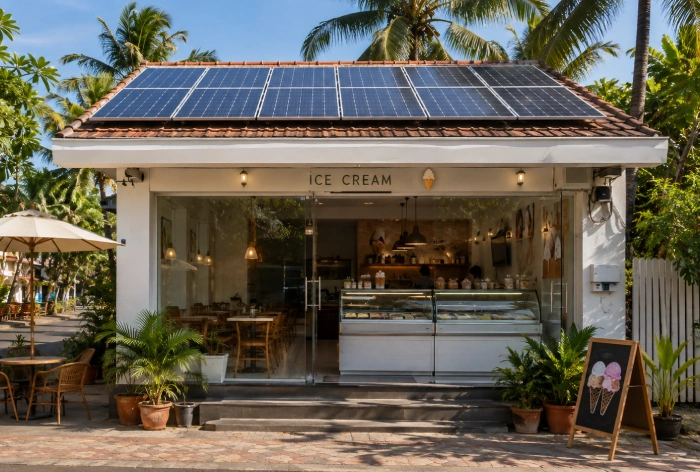
Ice cream parlours and cold beverage shops in Goa depend heavily on electricity. Deep freezers, display coolers, refrigerators, bottle chillers, lighting, fans, air conditioners, billing counters, signage, and small appliances can run for long hours every day.
Unlike some businesses that can temporarily reduce electricity usage, a cold-product shop cannot casually switch off its refrigeration equipment. Products need to remain at suitable temperatures, and any interruption can affect stock quality and customer service.
This makes electricity a major operating consideration. Rooftop solar may help reduce daytime dependence on grid electricity, but the system must be planned around the shop’s actual refrigeration load, operating hours, roof space, and future business requirements.
Solar De Goa helps commercial property owners evaluate solar through electricity bill review, daytime load assessment, roof inspection, system sizing, and practical savings estimation.
If you operate an ice cream parlour or cold beverage shop in Goa, ask Solar De Goa to assess your electricity usage and determine whether rooftop solar is suitable for your business.
Direct Answer: Can Solar Reduce Refrigeration Costs?
Solar can help reduce the grid electricity used by a shop during daylight hours. If freezers, coolers, lights, ACs, and billing equipment operate during the day, solar generation may support part of that active electricity demand.
However, solar savings depend on the system size, usable roof space, shade, equipment load, operating schedule, electricity consumption, and installation quality.
A business owner should not choose a system based only on the number of freezers. The complete electricity-use pattern should be reviewed first.
Why Refrigeration Makes Electricity Planning Important
Refrigeration is central to an ice cream or cold beverage business. Equipment may include:
- Deep freezers
- Glass-top display freezers
- Upright coolers
- Bottle chillers
- Storage refrigerators
- Ice-making equipment
- Preparation counters
- Air conditioning
- Outdoor and indoor signage
Some equipment may operate continuously, while other appliances cycle on and off depending on temperature, usage, and operating conditions.
This means the stated equipment rating alone does not provide a complete solar recommendation. Electricity bills and actual business usage give a clearer picture.
Businesses with continuous refrigeration loads often have electricity usage patterns similar to larger food retailers. Our guide on solar for supermarkets and grocery stores in Goa explains how rooftop solar can support refrigeration, lighting, and other daytime commercial loads.
Daytime Usage Can Improve Solar Value
Many ice cream parlours and beverage shops open from late morning through the evening. During daylight hours, refrigeration, lighting, fans, ACs, billing counters, and preparation equipment may operate together.
This daytime usage can make rooftop solar commercially relevant because the business may consume solar-generated electricity while it is being produced.
The stronger the match between business consumption and solar-generation hours, the more useful a properly planned system may become. This should still be assessed property by property rather than assumed.
What Happens After Sunset?
Solar panels produce electricity during available daylight. However, ice cream freezers and refrigerators may need to continue operating after sunset and while the shop is closed.
A standard grid-connected solar system can reduce daytime grid usage, but the shop may continue drawing electricity from the grid when solar generation is unavailable.
Business owners should not assume that installing panels will independently operate refrigeration equipment throughout the night. If backup is a concern, it should be discussed separately from daytime savings.
Solar De Goa can help business owners understand the difference between reducing daytime electricity costs and planning backup for essential equipment.
Roof Space and Shop Ownership
Some cold beverage shops operate from independent buildings, while others are located in rented shops, markets, commercial complexes, or shared buildings.
Before planning solar, check:
- Who owns the roof?
- Does the shop have a separate electricity meter?
- Is written roof permission required?
- Is the roof shaded by nearby buildings or trees?
- Is there enough usable space?
- Can workers safely access the roof?
- Where can the inverter be placed?
- Is there a practical wiring route to the shop?
A rented shop may still be able to explore solar, but permission, lease duration, equipment ownership, and long-term value must be considered.If your business operates from a leased commercial property, roof ownership and landlord approval are important before investing in solar. Our guide on solar for rented shops in Goa explains the key permission, lease, and installation considerations.
Equipment Load Should Be Assessed Carefully
Two ice cream parlours may have very different electricity requirements.
A small takeaway outlet may have two freezers, a bottle cooler, lights, fans, and a billing counter. A larger parlour may have multiple display freezers, several ACs, food preparation equipment, seating areas, decorative lighting, and extended operating hours.
This is why generic solar packages can be misleading. A system should be sized using electricity bills, equipment information, daytime demand, available roof space, and future plans.
Factors That Affect Solar Savings
| Factor | Why It matters |
| Number of freezers and coolers | Influences the shop’s refrigeration load |
| Operating hours | Shows how long equipment runs during solar-generation hours |
| Air-conditioning use | Can add significant daytime consumption |
| Monthly electricity usage | Helps assess current power demand |
| Roof space and shade | Affects possible system capacity and generation |
| Seasonal demand | Sales and cooling requirements may change through the year |
| System size | Must be matched to usage and available space |
| Installation quality | Supports dependable system operation |
The final savings should be estimated from the individual business rather than promised as a fixed percentage.
Solar as an Operating-Cost Decision
For an ice cream parlour, solar should be treated as a business investment rather than only a sustainability upgrade.
The right questions include:
- How much electricity does the shop use?
- How much of that usage occurs during the day?
- Is the roof suitable for solar?
- What system size can the property support?
- How long does the business expect to remain at the location?
- What is included in the commercial solar quote?
- What service support will be available?
Solar De Goa can help answer these questions through a commercial site assessment.
Common Mistakes to Avoid
Do not select solar based only on the cheapest quotation. Panel quality, inverter selection, mounting structure, wiring, safety, installation scope, and service support all matter.
Do not assume that solar will completely remove the electricity bill. Refrigeration may continue operating at night, and the business may still use grid electricity.
Do not size the system from equipment labels alone. Historical bills and actual operating patterns are also important.
Do not ignore roof permission when operating from a rented or shared property.
FAQ
Is solar suitable for an ice cream parlour in Goa?
It may be suitable if the business has regular daytime electricity usage, sufficient roof space, and clear permission to install solar.
Can rooftop solar operate deep freezers?
Solar generation can support the shop’s combined daytime electricity demand. The actual contribution depends on system capacity and total usage.
Will my freezers work on solar after sunset?
A normal grid-connected system does not generate electricity after sunset. Night-time operation and backup requirements should be discussed separately.
Can a rented cold beverage shop install solar?
Possibly, but landlord permission, roof rights, electricity metering, lease duration, and equipment ownership should be clarified first.
Can Solar De Goa assess refrigeration-heavy businesses?
Yes. Solar De Goa can review electricity bills, equipment usage, rooftop conditions, and operating hours before recommending a commercial solar setup.
Final Verdict
Ice cream parlours and cold beverage shops in Goa may be strong candidates for rooftop solar because refrigeration, lighting, cooling, and billing equipment often create steady daytime electricity demand.
However, a successful system must be planned around the complete business load. Freezer count alone is not enough. Electricity bills, operating hours, roof space, shop ownership, night-time consumption, and future plans should all be reviewed.
Solar De Goa helps refrigeration-heavy businesses evaluate solar through bill review, site inspection, system planning, and practical savings guidance.
Request a customized commercial solar assessment from Solar De Goa and understand how rooftop solar could support your ice cream parlour or cold beverage shop.