
Goa is currently witnessing a massive shift in how residents and business owners think about electricity. With the launch of the PM Surya Ghar: Muft Bijli Yojana, which offers subsidies of up to ₹2 lakh for residential systems, the focus has moved from “if” you should go solar to “which technology” you should choose. While standard panels are common, a premium technology known as HJT solar panels (Heterojunction Technology) is quickly becoming the gold standard for those who want the absolute maximum return from their roof space.
At Solar De Goa, we specialize in bringing the latest advancements in PV technology to our coastal state. Because Goa faces unique environmental stressors like high salinity and extreme humidity, choosing the right panel type is critical. To help you decide if this high-tech solution is right for you, Solar De Goa also does free on-site consultations, where we can analyze your specific roof and energy needs in person.
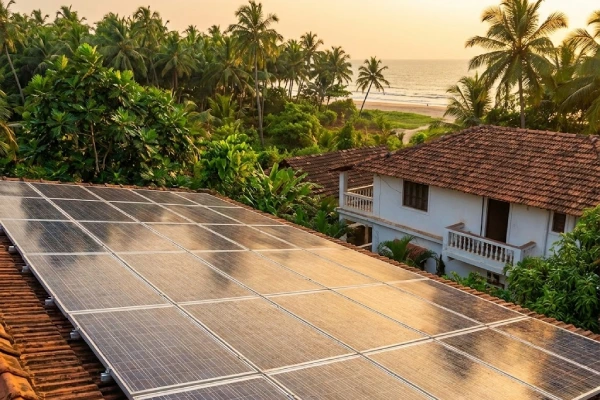
What are HJT Solar Panels?
Heterojunction technology is essentially a “hybrid” approach to solar cell construction. Unlike traditional panels that use a single layer of crystalline silicon, HJT cells combine crystalline silicon with two layers of “amorphous” (thin-film) silicon.
This combination allows the panel to capture more light and convert it into electricity with significantly higher efficiency. In fact, HJT technology has achieved record cell efficiencies exceeding 24.7%. For a homeowner in Goa, this means you can generate more power from a smaller number of panels, which is ideal for bungalows or villas with limited or complex roof structures.
What are the Pros of HJT?
The primary reason customers choose HJT solar panels is their superior performance in real-world conditions, particularly in climates like ours.
- Higher Efficiency: HJT modules, such as those launched by REC Solar, often reach efficiencies around 21.7% or higher at the module level. This outperforms standard PERC technology, which currently benchmarks closer to 19%.
- Lower Temperature Coefficient: Solar panels actually become less efficient as they get hot. HJT panels are famous for their ability to stay efficient even during the scorching Goan summer, losing less power to heat than traditional modules.
- Superior Surface Passivation: The “intrinsic thin layer” in HJT provides excellent surface passivation, which reduces the “leakage” of electrons and ensures more of the captured sunlight is turned into usable solar electricity for home use.
- Bifacial Capabilities: Many HJT panels are bifacial, meaning they can capture light from both the front and the back, further increasing your total energy yield.
What are the Cons of HJT?
While the technology is impressive, it is important to consider the potential drawbacks before making an investment.
- Higher Initial Cost: Advanced technology concepts like HJT often require more sophisticated manufacturing processes, which can increase the initial capital expenditure (CAPEX) compared to standard PERC panels.
- Manufacturing Complexity: Because HJT involves multiple layers and specific handling of thin wafers, it can be more challenging to produce at a mass scale, though this is rapidly changing as the industry adopts new standards.
At Solar De Goa, we believe the long-term energy savings and higher power output often justify the higher upfront price, especially when considering the 25-year operational life of the system.
Are HJT Panels Suitable for Residential Use?
Absolutely. In fact, they are often the best solar panel for home owners who have limited roof space but high electricity bills. Are hjt panels suitable for residential use? Yes, because their high power density allows a 3 kW or 5 kW system to be installed using fewer modules than standard technology would require.
Furthermore, HJT panels are highly resilient against Potential-Induced Degradation (PID), a common issue in humid areas where voltage stress and moisture combine to reduce a panel’s efficiency. In a state like Goa, where relative humidity stays between 70% and 95% for much of the year, this resilience is a major advantage.
What is the Lifespan of HJT Solar Panels?
When making a major investment, every homeowner asks: what is the lifespan of hjt solar panels? Like most high-quality crystalline silicon systems, HJT panels are designed for a lifespan of 25 years or more.
Because HJT panels are often built with high-durability materials to protect their sensitive hybrid layers, they typically come with robust performance warranties. These warranties often guarantee that the panels will still produce over 80-90% of their original power even after two decades of use. To ensure your panels reach this full lifespan in Goa’s saline air, Solar De Goa uses coastal-grade mounting structures made of anodized aluminum or SS316-grade steel.
Why Choose Solar De Goa for Your Installation?
Navigating the technical differences between solar panel types can be overwhelming. As a local expert and GEDA-empanelled partner, Solar De Goa handles the entire process for you.
We ensure that your system is correctly registered on the Goa Solar Portal so you can claim your government subsidies without any administrative headaches. Our team specializes in “Goa-proofing” your installation, using IP68-rated junction boxes and specialized coatings to prevent the “thin white film” of salt deposition from stealing your energy.
Frequently Asked Questions (FAQ)
Yes. Under the PM Surya Ghar Muft Bijli Yojana, residential consumers are eligible for significant Central and State subsidies. However, for the central portion of the subsidy, the panels must meet Domestic Content Requirements (DCR). During our free on-site consultation, we can help you select HJT panels that qualify for these incentives.
HJT panels are excellent at capturing low-light irradiance. While all solar production drops on very cloudy days, HJT’s superior efficiency helps you squeeze every possible watt out of the gray skies.
The cleaning process is the same as standard panels. However, in Goa, we recommend monthly cleaning with demineralized water to remove salt and dust buildup, which can reduce capture by 5% to 20%.
Since HJT panels are often bifacial, their placement is key to capturing reflected light from the roof surface. We perform a proper shadow analysis during our site survey to ensure your panels are positioned for maximum gain.
You can simply submit an inquiry through the “Apply for RTPV” section on the Goa Solar Portal. Alternatively, you can contact us directly for a streamlined experience.