
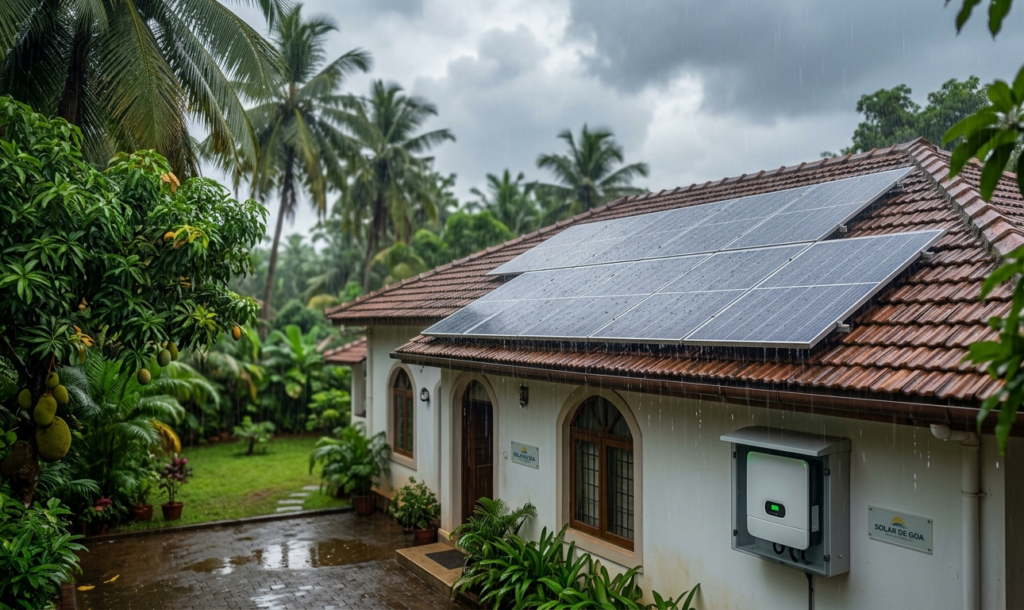
If you live in Goa and are thinking about installing solar, one question probably comes up before anything else: do solar panels work in monsoon Goa? It is a fair concern. Goa receives heavy rainfall, long stretches of cloud cover, high humidity, and coastal weather that can make homeowners wonder whether solar is practical for half the year.
The good news is that solar panels absolutely do work during the monsoon. They may not produce as much electricity on rainy or heavily overcast days as they do in peak summer sunshine, but they still generate power. More importantly, a well-designed system in Goa is evaluated across the full year, not just one season. That means your savings are based on annual production, seasonal balance, and the right system sizing for your home or business.
In this guide, we will explain how solar performs in the rainy season, what kind of savings you can still expect, and when battery backup is worth considering for homes in coastal Goa.
Do solar panels generate power during cloudy and rainy days?
Yes, solar panels do generate electricity during cloudy weather and rainy days. Solar modules do not need direct, harsh sunlight to work. They use daylight, and even when the sky is covered with clouds, diffused solar radiation still reaches the panels.
This is why the answer to do solar panels work in monsoon Goa is clearly yes. However, output does drop compared to bright summer days. On a clear day, a solar system may operate near its ideal generation range for several hours. During the monsoon, production becomes lower and more uneven depending on cloud density, rain intensity, roof orientation, and shading from nearby trees or buildings.
For homeowners researching solar in cloudy weather Goa, it helps to think of solar output like this: monsoon reduces production, but it does not shut the system down. Light rain, thin cloud cover, and bright overcast skies can still support meaningful generation. In fact, cooler temperatures during rainy weather can sometimes help panel performance, because solar panels generally operate more efficiently at lower temperatures than in extreme heat. The real reduction comes from lower sunlight availability, not from the rain itself.
Another point many people overlook is that rain can actually help wash dust, pollen, and surface dirt off the panels. In dry months, dirt buildup may slowly reduce performance. During the monsoon, natural cleaning can improve panel cleanliness, although salty coastal deposits and stubborn grime may still require periodic professional maintenance.
So when people ask about solar output rainy season Goa, the practical answer is this: output is lower than summer, but far from zero. A properly installed system continues producing energy throughout the season.
How monsoon affects annual bill savings
The biggest mistake people make is judging solar based only on the worst weather month. Solar is not designed around one rainy week or one dark month. It is designed around annual energy production.
Goa gets strong sunlight for much of the year outside the peak monsoon period. That means your solar system usually generates higher output in the dry and sunny months, helping offset the reduced production during the rainy season. Over the course of a full year, those stronger months are what make solar financially attractive.
This is why monsoon solar efficiency Goa should be understood as a seasonal variation, not a system failure. Monsoon months may reduce your immediate solar generation, but your annual savings can still be substantial if the system is sized correctly for your energy use.
For example, if your home consumes significant daytime electricity for fans, refrigerators, pumps, office equipment, or air conditioning, solar can reduce grid consumption for most of the year. During the monsoon, you may draw more electricity from the grid than you do in summer, but your total yearly electricity bill can still be much lower than before solar installation.
Net metering also plays a major role here. In many cases, extra electricity generated during strong production months can help balance lower production periods, depending on your approved setup and billing structure. This makes rooftop solar even more attractive for Goa homeowners because the system’s value is spread across the full annual cycle.
The key is not to expect identical output every month. Solar is seasonal. What matters is whether the total energy produced over the year justifies the investment. In Goa, for many homes and commercial properties, the answer is yes.
Is solar still worth installing in coastal Goa?
Yes, solar is still worth installing in coastal Goa, but it must be designed for local conditions. Goa is not just rainy. It is also humid, salty, and exposed to strong winds in many areas. That means equipment quality and installation standards matter a lot more here than in inland regions.
A good solar system for coastal Goa should use corrosion-resistant mounting structures, reliable inverters, proper cable protection, and installation practices suited to moisture-heavy environments. If low-quality components are used, the issue is not that solar “doesn’t work” in Goa. The issue is that the system was never built properly for Goa in the first place.
For decision-makers asking whether solar is worth it despite the monsoon, there are three practical reasons why it still makes sense:
First, Goa has strong solar potential across the rest of the year. Monsoon is intense, but it does not last twelve months.
Second, electricity prices and long-term energy costs remain a concern for many households, villas, homestays, and small businesses. Solar helps create more predictable energy costs.
Third, modern solar systems are more efficient and reliable than many people assume. Even in mixed weather conditions, they can provide strong annual returns when planned well.
So yes, if you are wondering whether do solar panels work in monsoon Goa and whether they are still worth buying, the answer is that they work, and they can absolutely still be worth the investment in coastal areas when installed by an experienced local provider.
When battery backup makes sense
A solar panel system and a battery backup system are related, but they are not the same thing. Standard grid-connected solar systems reduce your electricity bill by generating power during the day. However, if the grid goes down, many systems automatically shut off for safety reasons unless battery backup is included.
This is where battery backup solar Goa becomes important.
Battery backup makes sense in a few common situations:
1. You experience frequent power cuts
If your area faces repeated outages during heavy rain or storms, battery storage can keep essential appliances running, such as lights, Wi-Fi, fans, refrigerators, and security systems.
2. You want backup for night-time use
Solar panels generate electricity during daylight hours. If you want to use stored solar energy after sunset, a battery can help shift some of that power into the evening.
3. You run a home office, clinic, shop, or rental property
For people who depend on uninterrupted power, battery backup adds convenience and resilience that pure grid-tied solar cannot provide on its own.
4. You want greater energy independence
Some homeowners simply prefer less dependence on the grid, especially during the monsoon when weather-related disruptions are more common.
That said, batteries increase the total cost of the system. They are not necessary for everyone. If your main goal is to lower your electricity bill and your grid supply is fairly stable, a standard on-grid solar system may be enough. If backup power is important, then a hybrid system with batteries may be the better solution.
Final thoughts
So, do solar panels work in monsoon Goa? Yes, they do. Solar panels continue generating power during cloudy and rainy weather, though at lower levels than in bright sunshine. Monsoon does affect short-term production, but that does not cancel out the strong annual savings solar can deliver in Goa. The real key is smart system design, high-quality components, and choosing whether battery backup is necessary for your property.
If you are planning to go solar in Goa, it is important to work with a company that understands local coastal conditions, monsoon performance, roof suitability, and backup options. Solar De Goa helps homeowners and businesses choose the right solar solution for Goa’s unique climate, from efficient rooftop systems to reliable backup-ready setups. If you want a system that performs not just in summer but through every season, Solar De Goa is the team to talk to.
FAQs
1. Do solar panels work during heavy rain in Goa?
Yes, solar panels still work during heavy rain, but their electricity generation drops because less sunlight reaches the panels. They do not stop working completely unless weather conditions are extremely dark for long periods.
2. How much does monsoon reduce solar output in Goa?
Solar output during the rainy season is usually lower than in summer because of cloud cover and shorter bright sunlight hours. However, the system continues to generate electricity, and annual savings are calculated over the whole year, not just the monsoon months.
3. Is solar still worth it in coastal Goa with so much humidity?
Yes, solar is still worth it in coastal Goa if the system is installed with good-quality, corrosion-resistant components. Proper design and maintenance are important because coastal humidity and salt air can affect lower-quality systems.
4. Do I need battery backup with solar in Goa?
Not always. If your main goal is to reduce electricity bills, a normal on-grid solar system may be enough. Battery backup makes more sense if you face frequent power cuts or want electricity available during outages and at night.
5. Can cloudy weather in Goa completely stop solar generation?
No, cloudy weather does not completely stop solar generation. Panels can still produce electricity from diffused daylight, although output will be lower compared to clear sunny days.