
Goa’s energy landscape is undergoing a massive transformation. With the launch of the PM Surya Ghar: Muft Bijli Yojana, the dream of generating your own power and reducing your electricity bill to zero is now a reality for thousands of Goan households. However, as you begin your solar journey, you will likely encounter a technical term that is critical to your financial success: the DCR solar panel in Goa.
At Solar De Goa, we believe that an informed customer is a satisfied one. Navigating the requirements for government incentives can be complex, but we are here to simplify the process. From explaining what is DCR solar panel? to helping you meet PM Surya Ghar Muft Bijli Yojana Goa eligibility, our team provides end-to-end support. To get you started on the right foot, Solar De Goa also does free on-site consultations to evaluate your roof and explain these requirements in person.
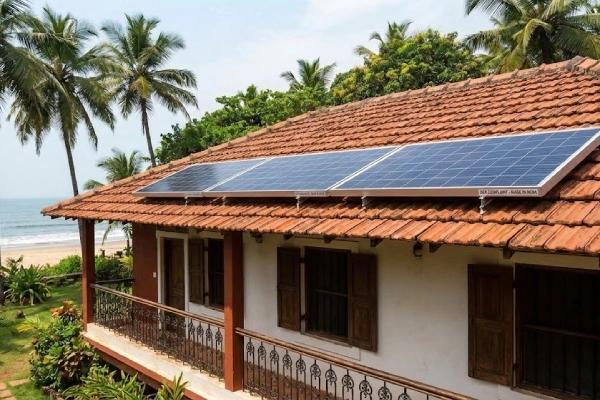
What is DCR Solar Panel?
If you are looking to avail of the massive subsidies offered by the Central and State governments, you must understand the Domestic Content Requirement (DCR). So, what is DCR solar panel? In simple terms, DCR modules are solar panels where both the solar cells and the solar modules are manufactured domestically in India.
Under the current guidelines for the PM Surya Ghar scheme, using DCR-compliant modules is an essential condition for residential consumers to be eligible for Central Financial Assistance (CFA). If an installation uses non-DCR modules, it is rendered ineligible for the subsidy entirely. This policy is designed to empower the local economy and ensure energy security by reducing dependence on imported technology.
DCR vs Non-DCR Solar Panels
When comparing DCR vs Non-DCR solar panels, the primary difference lies in their origin and subsidy status.
- Manufacturing Origin: DCR panels use cells and modules made in India. Non-DCR panels often use imported cells, which are then assembled into modules locally or imported as finished products.
- Subsidy Eligibility: This is the most significant factor for homeowners. Only DCR panels qualify for the PM Surya Ghar subsidy. While you are free to install non-DCR panels if you choose to do without the government subsidy most residential consumers find that the financial benefits of DCR panels far outweigh the alternatives.
- Quality and Standards: Both types must adhere to strict quality standards. DCR panels must be included in the Approved List of Models and Manufacturers (ALMM) and comply with various BIS and IEC standards to ensure they survive Goa’s high-salinity environment.
The Benefits of DCR Solar Panels
Choosing a DCR solar panel in Goa offers a unique combination of financial and technical advantages.
- Massive Financial Savings: The most obvious of the benefits of DCR solar panels is the access to subsidies. In Goa, a residential consumer installing a 3 kW system can receive total subsidies of up to ₹2 lakh. This includes ₹78,000 from the Central government and a generous 30% supplement from the Goa state government.
- Tailored for the Climate: DCR panels approved for the Goan market are tested for Salt Mist Corrosion (IEC 61701). This is critical for our coastal state, where salt-laden winds can otherwise lead to an annual power degradation of 10–12%.
- Long-term Reliability: Panels used under the government scheme must have a nominal power output of at least 90% for the first 10 years and 80% for the following 15 years.
- Simplified Maintenance: Vendors providing DCR panels under the scheme are required to provide 5 years of free comprehensive maintenance.
PM Surya Ghar Muft Bijli Yojana Goa Eligibility
To ensure your home qualifies for the “Free Electricity Scheme,” you must meet the PM Surya Ghar Muft Bijli Yojana Goa eligibility criteria:
- Residential Status: The scheme is exclusively for residential households.
- Valid Connection: You must have a valid Consumer Account Number from the Goa Electricity Department.
- Consumption Limits: While the scheme aims to provide up to 300 units of free power, those who have historically used 400 or fewer units per month for the previous 12 months are often prioritized under state-specific initiatives like the Goem Vinamulya Vij Yevjan.
- Technical Requirements: You must use an empanelled vendor and install DCR solar panels to receive the financial assistance.
The Application Process in Goa
Applying for a solar panel system for home use has been streamlined through the Goa Solar Portal, a unified window for all rooftop applications.
The steps generally involve:
- Registration: Submitting an inquiry through the “Apply for RTPV” section.
- Feasibility Analysis: GEDA and your chosen vendor will assess your roof’s suitability and shadow-free area.
- Net Metering: Your vendor will apply for a bi-directional meter, which acts as a “power bank,” allowing you to export excess energy during the day and use it at night.
- Installation: Once technical approvals are in place, the DCR modules are installed, and the system is synchronized with the grid.
Why Choose Solar De Goa?
Navigating the nuances of DCR requirements and state-specific subsidies can be daunting. As a local expert, Solar De Goa ensures that every panel we install meets the strict DCR standards required for your subsidy. We don’t just provide hardware; we provide a pathway to energy independence.
We understand that every Goan home is different, which is why Solar De Goa provides a free on-site consultation. We will visit your property, conduct a professional shadow analysis, and provide a detailed ROI report showing how quickly your system will pay for itself—typically within eight to nine years in Goa.
Frequently Asked Questions (FAQ)
No. To be eligible for the PM Surya Ghar subsidy, you must use DCR solar panels, which utilize cells and modules manufactured in India.
A standard 3 kW solar plant typically requires approximately 30 square meters of shadow-free rooftop area.
Solar panels collect light, not heat. While production may be lower on very cloudy days, your system will still generate electricity. Because you are connected via Net Metering, you can draw the power you need from the grid using the credits you banked during the sunnier months.
Yes. For a 3 kW system, you get a fixed ₹78,000 from the Centre, and the Goa State Government provides an additional 30% subsidy on the system cost.
High-quality DCR modules are designed to operate for 25 years. They come with performance warranties that guarantee they will still be highly efficient even after two decades of use.