
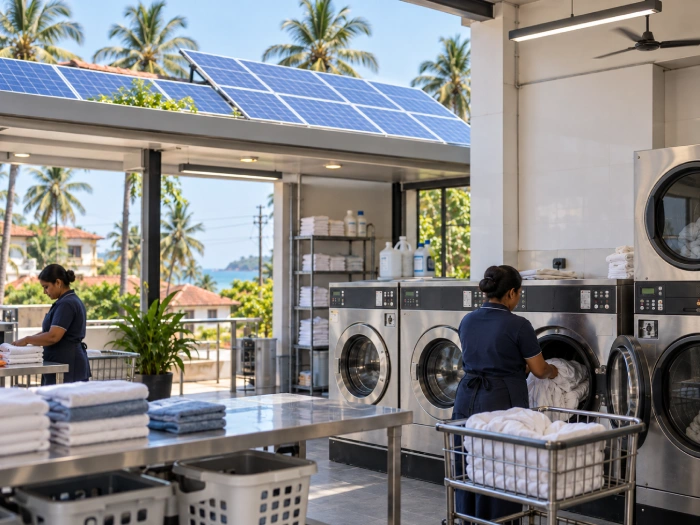
Laundries and dry-cleaning shops in Goa can use significant amounts of electricity during normal working hours. Washing machines, tumble dryers, steam equipment, irons, pressing machines, water pumps, air conditioners, fans, lighting, billing systems, and other equipment may all contribute to the monthly power bill.
Unlike some businesses where electricity use is spread evenly across the day and night, many laundry operations carry out most of their work during daytime business hours. This can make rooftop solar worth evaluating as a way to reduce dependence on grid electricity while equipment is actively running.
However, solar should not be planned by counting machines alone. The installer should understand the actual electricity bills, operating hours, equipment ratings, simultaneous usage, roof space, and whether the business operates from an owned or rented property.
Solar De Goa helps commercial businesses assess electricity consumption, daytime loads, rooftop suitability, and system requirements before recommending a solar setup.
If you run a laundry or dry-cleaning shop in Goa, Solar De Goa can review your electricity bills and operating pattern to help you understand whether rooftop solar is practical for your business.
Direct Answer: Is Solar Useful for Laundries and Dry-Cleaning Shops?
It can be.
Laundries and dry-cleaning businesses often use electricity during the day for washing, drying, pressing, ventilation, AC, pumps, and lighting. When this demand overlaps with solar-generation hours, rooftop solar may help reduce the amount of electricity drawn from the grid.
The actual value depends on equipment usage, system size, roof conditions, operating hours, electricity consumption, and installation quality.
A proper commercial solar assessment should therefore look at how the business operates, not only the total bill.
Laundry businesses have different power requirements from homes, so the system should be designed around commercial consumption, operating hours and actual site conditions. Read our guide to commercial solar installation in Goa to understand the broader factors businesses should consider before installing rooftop solar.
Washing Machines Create Repeated Daytime Loads
Commercial washing machines may run through several cycles during the working day.
The electricity demand depends on:
- Number of machines
- Machine capacity
- Number of daily cycles
- Water-heating arrangement
- Whether multiple machines operate together
- Business operating hours
- Seasonal workload
A small neighbourhood laundry with two machines will have a very different usage pattern from a larger commercial laundry handling hotel linen, uniforms, or bulk cleaning.
Solar planning should reflect these differences.
Solar De Goa can review actual consumption and equipment use before recommending system capacity.
Dryers Can Change the Power Profile
Dryers may be one of the more significant electrical loads in some laundry businesses, particularly when several machines operate repeatedly.
But not every laundry uses the same drying system. Some businesses use electric dryers, while others may depend partly on natural drying, gas-based equipment, or a combination.
This means the installer should confirm:
- Dryer type
- Electrical rating
- Number of daily drying cycles
- Whether washers and dryers operate at the same time
- When most drying occurs
- Whether capacity may increase later
A solar system should not be sized simply from the total connected equipment rating. Historical electricity bills and real operating patterns provide a better starting point.
Irons, Pressing Equipment, and Steam Systems Matter Too
Ironing and finishing are another important part of laundry and dry-cleaning operations.
Depending on the business, this may involve:
- Electric irons
- Steam irons
- Pressing tables
- Garment presses
- Steam-generating equipment
- Finishing equipment
These loads may operate for several hours during the day, especially in high-volume businesses.
If washing, drying, pressing, AC, and lighting all run at the same time, the combined daytime demand can become substantial.
This is why a complete load assessment is more useful than focusing on one machine.
AC and Ventilation Can Add Steady Consumption
Laundry spaces can become warm and humid because of washing, drying, steaming, and pressing operations.
Some shops rely on fans and exhaust systems, while others use air conditioning for staff comfort, customer areas, or garment-handling spaces.
These systems can create a steady daytime electricity load.
When AC, ventilation, washing machines, dryers, irons, pumps, and lighting operate during daylight hours, part of that demand may align well with rooftop solar generation.
The exact benefit should still be calculated from the individual business rather than assumed.
Water Pumps and Other Hidden Loads
Electricity use in a laundry does not come only from the visible machines.
Other loads may include:
- Water pumps
- Pressure pumps
- Lighting
- CCTV
- Computers
- Billing systems
- Signage
- Small office equipment
- Water-treatment equipment
- Ventilation fans
These smaller loads can add up across long operating hours.
A good commercial solar assessment should therefore review the entire site.
What If the Laundry Operates from a Rented Shop?
Many laundry and dry-cleaning businesses operate from rented commercial spaces.
Before installing solar, confirm:
- Who owns the roof?
- Is written landlord permission available?
- Does the shop have a separate electricity meter?
- How long is the remaining lease?
- Is the roof shared with other businesses?
- Where can the inverter be installed?
- Can the solar equipment remain if the business relocates?
A long-term solar investment should make sense for both the property arrangement and the expected business tenure.
Solar De Goa can review these factors during a commercial site assessment.
What Affects Solar Savings?
| Factor | Why It Matters |
| Number of washers | Influences daytime load |
| Dryer usage | Can create significant electrical demand |
| Pressing equipment | Adds to active daytime consumption |
| AC and ventilation | May operate continuously during business hours |
| Daily operating hours | Determines overlap with solar generation |
| Monthly electricity use | Helps estimate commercial demand |
| Roof space | Limits practical system capacity |
| Property ownership | Affects permission and long-term value |
| Future expansion | New equipment may change electricity needs |
The final savings should be estimated using actual electricity consumption and site conditions rather than promised as a fixed percentage.
Example: Two Laundry Businesses
Imagine two laundries in Goa.
Laundry A runs several washing and drying cycles from morning through late afternoon. Pressing equipment, fans, lighting, and pumps also operate throughout the day.
Laundry B carries out most heavy machine work in the evening and uses the shop mainly for customer collection during daylight hours.
Both may have similar monthly bills, but Laundry A may have a stronger direct daytime solar-use pattern.
This is why operating hours matter as much as the total bill.
Common Mistakes to Avoid
Do not choose a solar system only from the number of machines.
Do not assume every connected appliance operates at full power throughout the day.
Do not assume solar will eliminate the entire electricity bill, especially if machines continue running after sunset.
Avoid ignoring rented-property permission or roof access.
Also, do not select the cheapest commercial quote without checking panel, inverter, mounting structure, wiring, safety, service, and system-design details.
Questions to Ask Before Installing Solar
Before approving a solar proposal, ask:
- How much electricity does the laundry use each month?
- When do washers and dryers operate?
- Which machines run at the same time?
- How much electricity is used during daylight?
- Is the roof suitable?
- Is landlord permission required?
- What system size is being proposed and why?
- What is included in the quotation?
- Can the system accommodate future equipment expansion?
- What monitoring and service support is available?
These questions help turn solar into a practical business investment.
FAQ
Is solar suitable for laundry businesses in Goa?
It can be suitable when the business has regular daytime electricity use, suitable roof space, and a practical installation location.
Can solar support washing machines and dryers?
Solar generation can contribute to the business’s combined daytime electricity demand. The actual contribution depends on system size and total consumption.
Will rooftop solar reduce dryer electricity costs?
It may reduce daytime grid consumption when dryers operate while solar power is being generated.
Can a rented laundry shop install solar?
Possibly, but roof permission, lease duration, meter details, and system ownership should be clarified first.
Can Solar De Goa assess a laundry or dry-cleaning business?
Yes. Solar De Goa can review electricity bills, equipment usage, operating hours, and roof conditions before recommending a commercial solar system.
Final Verdict
Laundries and dry-cleaning shops in Goa may be strong candidates for rooftop solar when washers, dryers, pressing equipment, AC, ventilation, pumps, and lighting create regular daytime electricity demand.
But the system should not be selected from machine count alone. Electricity bills, operating schedules, simultaneous equipment use, roof space, lease conditions, and future expansion should all be reviewed.
Solar De Goa helps laundry and dry-cleaning businesses evaluate these factors through electricity-bill analysis, rooftop inspection, and customized commercial solar planning.
Request a commercial solar assessment in Goa from Solar De Goa and understand how rooftop solar could reduce grid electricity use for your laundry or dry-cleaning business.