
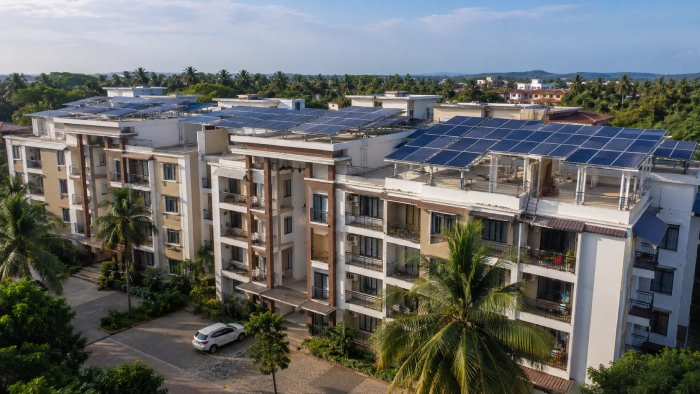
Apartment associations in Goa often pay recurring electricity bills for common areas. These expenses may include water pumps, parking lights, staircase lighting, lifts, security systems, entrance gates, CCTV, clubhouses, offices, and outdoor lighting.
Rooftop solar may help reduce part of this shared electricity burden when the building has suitable roof space, a clear common-area meter, and agreement among the association members.
However, an apartment solar project is not the same as installing panels on an independent house. The association must first understand roof rights, electricity usage, committee approval, payment responsibility, installation access, metering, and future maintenance.
Solar De Goa can inspect the building, review common electricity bills, assess the rooftop, and help the association understand whether a shared solar project is practical.
If your apartment association is considering solar, arrange a Solar De Goa site assessment before collecting quotations or committing association funds.
Direct Answer: Can an Apartment Association Install Rooftop Solar?
An apartment association may be able to install rooftop solar for common-area electricity use if the roof is suitable, ownership and permission are clear, and the relevant members or committee approve the project.
The proposed system should be planned around the common electricity connection and actual shared loads. It should not be assumed that one common rooftop system will automatically reduce every apartment owner’s individual electricity bill.
The association should review the building’s legal, electrical, financial, and installation conditions before deciding.
Which Common-Area Loads Can Be Reviewed?
Apartment buildings may use electricity for several shared facilities, including:
- Water pumps
- Borewell or transfer pumps
- Lift systems
- Staircase and corridor lighting
- Parking-area lighting
- Entrance and compound lighting
- CCTV and security equipment
- Gate motors
- Association office equipment
- Clubhouse or gym facilities
- Sewage or water-treatment equipment
- Landscape and garden lighting
Not every apartment complex has the same load pattern. A smaller building may mainly use pumps and lighting, while a larger society may have several lifts, security facilities, common halls, and treatment systems.
Solar planning should begin with common-area electricity bills and equipment usage rather than the number of apartments alone.
Confirm Which Electricity Meter Will Benefit
Before discussing system size, the association should identify the electricity meter connected to the common facilities.
Important questions include:
- Is there a dedicated common-area meter?
- Which equipment is connected to it?
- Is the connection residential, commercial, or another category?
- Whose name appears on the bill?
- What is the sanctioned load?
- How much electricity is used during daylight hours?
- Are any common loads billed through separate meters?
If pumps, lifts, lights, and security systems are divided across multiple connections, the association may need additional assessment before deciding how solar should be planned.
Solar De Goa can review the available bills and help identify the electricity usage relevant to the proposed project.
Roof Permission and Association Approval
The building roof is usually a shared area rather than the private property of one apartment owner. The association should therefore confirm its authority to use the roof and follow its own rules for approving common-property work.
Depending on the building and its governing documents, the decision may require:
- A committee discussion
- A general-body meeting
- A formal resolution
- Approval from a specified percentage of members
- Review of building or society documents
- Written acceptance of project cost
- Agreement on roof access and maintenance
- Approval of the selected installer and quotation
Solar should not be installed only because a few residents support the idea. The decision and responsibilities should be recorded clearly.
Check Whether the Roof Is Actually Usable
A large apartment roof does not always provide a large usable solar area. It may contain water tanks, lift rooms, pipes, dish antennas, parapet walls, existing solar water heaters, clothes-drying areas, or equipment belonging to individual residents.
The installer should assess:
- Available shadow-free space
- Water-tank and lift-room shade
- Safe access for workers
- Maintenance walkways
- Drainage and waterproofing
- Mounting-structure requirements
- Cable routes
- Inverter location
- Future roof repairs
- Fire and service access requirements
The proposed panel layout should preserve access to essential building equipment.
How Should the Association Evaluate Cost?
The project cost should be assessed as a shared infrastructure decision. The association should understand the complete quotation and how the expense will be funded.
Possible approaches may include association reserves, a special contribution, an agreed member payment, or an approved finance arrangement. The right option depends on the association’s rules and financial position.
Before approval, ask whether the quotation includes:
| Quotation Area | What the Association Should Confirm |
| Solar panels and inverter | Brands, capacity, and approved specifications |
| Mounting structure | Suitability for the building and roof |
| Wiring and protection | Scope, cable route, and safety components |
| Installation work | Labour, access, and material movement |
| Application support | Documents, approvals, and coordination included |
| Meter-related work | What is included and what may be separate |
| Monitoring | How performance will be checked |
| Service support | Maintenance responsibility and response process |
The committee should compare scope and quality rather than only the final price.
Consider Daytime and Night-Time Loads
Solar generation is available during daylight, while some apartment loads operate throughout the day and night.
Water pumps, association offices, daytime lift use, security systems, and common lighting schedules may create different consumption patterns. Parking and staircase lighting may be used mainly after sunset.
This does not make solar unsuitable. It means the installer should review when electricity is used, not only the monthly total.
The association should also avoid assuming that rooftop panels automatically provide backup during power cuts. Backup requirements should be evaluated separately.
Long-Term Value for the Association
A well-planned common-area solar system may help the association manage shared electricity expenses over time. It may also make operating costs more predictable and support the building’s long-term energy planning.
However, value depends on appropriate system sizing, installation quality, actual consumption, roof conditions, current billing rules, and ongoing maintenance.
The association should also plan for future committee changes. Important documents, warranties, approvals, monitoring access, service contacts, and system records should remain with the association rather than one individual member.
Create Clear Maintenance Responsibility
Before installation, decide who will:
- Review system monitoring
- Arrange cleaning or inspection
- Provide rooftop access
- Contact the installer when required
- Store project documents
- Report performance to members
- Approve future repair expenses
- Coordinate roof waterproofing or building work
Solar equipment should not be ignored after installation simply because it belongs to the common area.
Solar De Goa can explain service and monitoring requirements so the association can assign responsibility properly.
Questions the Committee Should Ask
Before approving the project, ask:
- Which common meter will the system support?
- How much common-area electricity is used?
- Is the roof legally and physically available?
- What approval must members provide?
- How will the project be funded?
- What system size is practical?
- What is included in the quotation?
- How will application and metering steps be handled?
- Who will maintain and monitor the system?
- How will future roof repairs be coordinated?
These questions help the association move from general interest to a responsible decision.
FAQ
Can rooftop solar reduce individual apartment bills?
A system connected to the common-area meter generally supports the electricity loads linked to that connection. Individual apartment benefits require separate evaluation.
Does every apartment owner need to approve the project?
Approval requirements depend on the association’s rules, governing documents, and applicable legal process. The committee should verify this before proceeding.
Can solar support lifts and water pumps?
Solar generation contributes to the building’s combined connected electricity demand during daylight. The system should be planned from actual bills and equipment usage.
Can panels be installed around rooftop water tanks?
Often yes, but tank shade, plumbing access, maintenance walkways, drainage, and usable roof space must be assessed.
Can Solar De Goa assess an apartment complex?
Yes. Solar De Goa can review common-area bills, inspect the rooftop, assess loads, and prepare a site-based solar proposal for the association.
Final Verdict
Solar for apartment associations in Goa can be a practical long-term decision when common-area loads, roof rights, association approval, metering, cost responsibility, and maintenance are understood clearly.
The committee should not begin with panel quantity or the cheapest quotation. It should begin with common electricity bills, usable roof space, member approval, and a professional site assessment.
Speak to Solar De Goa for an apartment solar assessment in Goa and receive a site-based proposal based on your association’s actual common-area electricity use and rooftop conditions.