
For many small manufacturing units in Goa, electricity is a steady monthly cost that rises and falls with production. Owners often hear that solar can reduce it, but they rarely get a clear way to judge whether their unit is a good fit. The answer starts with a simple question: how much of your power do you use while the sun is up? Machines, compressors, lighting and cooling that run during the day are what make solar worthwhile. At Solar De Goa, we help small units in Goa look at their loads and roof first, so the decision rests on facts rather than guesswork.
Want a load review for your unit? Contact Solar De Goa and share a few months of electricity bills.
Direct Answer
Solar tends to suit small manufacturing units that run most of their machines and lighting during daytime hours, have a roof that can safely carry panels, and have a stable electrical connection. We do not state savings percentages or payback periods here, because they depend on your tariff, load pattern, roof and system design. A review of your bills and operating hours is the reliable starting point.
Why Daytime Production Suits Solar
Solar panels produce power while there is daylight. If your unit runs most of its load at the same time, a good share of that production can be used on site instead of drawn from the grid. A unit that works mostly at night or has long idle gaps during the day may see a different result. This is why your operating pattern matters as much as your roof size. Our guide to daytime power usage and solar ROI in Goa explains the idea in more detail.
Which Loads to Map First
Before asking for a quote, list what runs and when. A simple load map often reveals more than the bill alone.
For example, a workshop that runs its machines from morning to late afternoon will usually match solar generation better than one that runs mainly after dark. These are general illustrations, not predictions for any particular unit.
Roof and Structure Checks
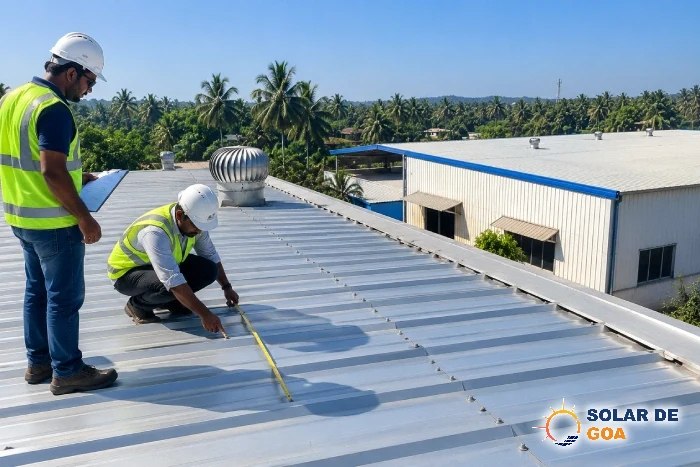
Many small units have metal sheet or older roofs. Before solar is planned, the roof’s condition, strength, slope, shade and access should be checked on site. Dust, nearby trees and equipment on the roof can also affect layout. Goa’s humid, salty air makes fixings and corrosion protection worth asking about as well.
Electrical Checks
A small unit often has a mix of single-phase and three-phase loads, older wiring and varying protection. Connecting solar to this setup is specialist work, covering the electrical panel, earthing, protection and metering. It must always be done by qualified professionals, and your installer should explain what they check before commissioning. A panel and earthing safety check is a sensible early step.
Subsidy and Approvals
The residential PM Surya Ghar subsidy is meant for homes and should not be assumed for a commercial or industrial unit. Metering and approval rules for businesses should be confirmed with the Goa Electricity Department or JERC and are subject to current rules. For any tax treatment, speak to your chartered accountant.
How Solar De Goa Helps
We start by reading your bills, understanding your operating hours and visiting your roof. We then explain what size and layout may make sense, and what to ask before committing. Our industrial solar services page explains how we approach production sites. If your unit is larger, see our guide to 100 kW solar plant cost in Goa for how cost planning changes at scale.
Questions to Ask Before You Commit
- How does the proposed size relate to my daytime load?
- Has my roof’s strength and condition been checked on site?
- What electrical work and protection are included?
- Which approvals are needed, and who handles them?
- What monitoring and service come after installation?
FAQ
Is solar worth it for a small factory in Goa?
It can be, especially when most machines and lighting run in daylight. A review of your bills, load pattern and roof will show whether it fits your unit.
How much can a manufacturing unit save with solar?
Savings depend on your tariff, load, roof and system design. We avoid fixed figures, and a site review gives a more reliable picture.
Does my unit qualify for the PM Surya Ghar subsidy?
The residential subsidy is intended for homes, so do not assume it applies to a commercial or industrial unit. Confirm current rules with the relevant authority.
Can solar run my machines directly?
Solar feeds your electrical system, and how it connects to your loads depends on the design. Your installer should explain this before work begins.
What documents should I share for a review?
Recent electricity bills, your operating hours, a list of major machines and photos of your roof are a good start.
Final Verdict
Solar suits small manufacturing units best when daytime load is high, the roof is sound and the electrical setup is checked by professionals. Map your loads first, and ask for a review before you ask for a price.
Ready to review your unit? Contact Solar De Goa and share a few months of bills for a load review.