
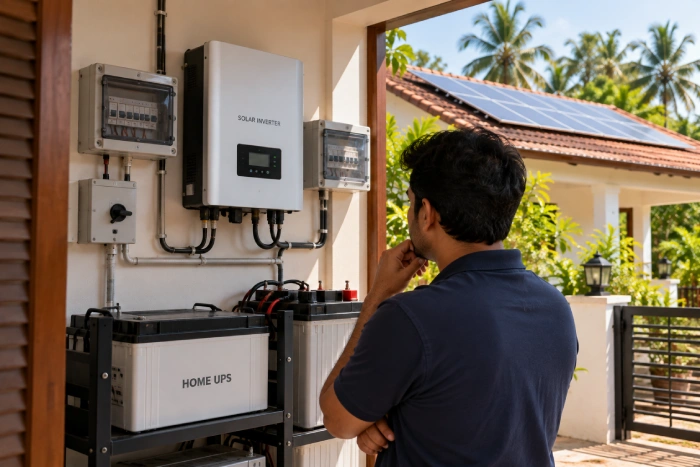
Many homes in Goa already have a home inverter, UPS, or battery backup system before they start considering rooftop solar.
So one of the first questions homeowners often ask is:
Do I need to replace everything when I install solar?
Not necessarily.
Some existing equipment may continue to be useful, while other components may not be suitable for integration with the new solar system. The answer depends on the type of inverter or UPS, battery condition, wiring, system design, backup expectations, and the type of rooftop solar being planned.
Solar De Goa can inspect your existing electrical and backup setup before recommending whether equipment should be retained, upgraded, separated, or replaced.
If you already have an inverter or UPS at home, ask Solar De Goa to assess it before you approve a new solar quotation. This can help avoid paying for unnecessary replacement or assuming old equipment will work when it is not compatible with the proposed system.
Direct Answer: Can an Existing Home Inverter Be Used with Solar?
Sometimes, but not always.
A standard home inverter or UPS is designed primarily to provide backup power from batteries during an outage. A solar inverter is designed to manage electricity generated by solar panels and operate as part of a specific solar system.
Some equipment may support solar integration, while older or conventional backup systems may need to remain separate.
The correct approach is to identify exactly what equipment you already own before deciding how the solar system should be designed.
Start by Identifying What You Already Have
Do not assume every box connected to a battery is the same.
Your existing setup may include:
- A standard home inverter
- A UPS
- A battery inverter
- A hybrid inverter
- One or more batteries
- Dedicated backup circuits
- Changeover switches
- Existing protection equipment
The installer should check the make, model, age, rating, condition, and function of the equipment.
This matters because two homeowners may both say, “I already have an inverter,” while their actual systems may be completely different.
A Normal Home Inverter and a Solar Inverter Are Not Automatically the Same
A traditional home inverter usually converts stored battery energy into usable household electricity during a power cut.
A solar inverter performs a different role. It manages electricity generated from rooftop solar panels and interfaces with the home’s electrical system according to the solar design.
Because their functions differ, an existing home inverter should not automatically be treated as a substitute for the inverter required by the new rooftop solar system.
Depending on the project, the old inverter may:
- Continue operating separately
- Remain as backup for selected circuits
- Be integrated through a compatible design
- Need replacement
- Become unnecessary
Solar De Goa can assess the actual equipment before deciding which option is appropriate. If you are considering a more integrated solar and backup setup, it is useful to understand how a hybrid inverter differs from a conventional home inverter. Read Solar De Goa’s guide to choosing a hybrid inverter for a home in Goa and the role it can play in managing solar, battery storage and grid electricity.
Existing Batteries Need to Be Checked Too
If your inverter or UPS uses batteries, their condition matters.
Questions to review include:
- How old are the batteries?
- What type are they?
- What capacity do they have?
- Are they still performing well?
- Are they compatible with the proposed equipment?
- Are they being used only for backup?
- Are they expected to work with the new solar system?
An old battery should not be assumed to have the same usable capacity it had when new.
Likewise, a battery being suitable for an existing UPS does not automatically mean it is suitable for every solar or hybrid system.
The installer should check compatibility rather than making assumptions from battery size alone.
What If You Only Want Solar to Reduce the Electricity Bill?
Not every homeowner needs battery-backed solar.
If your main goal is to reduce daytime grid electricity use, the proposed system may be designed differently from a system intended to provide backup during outages.
In that case, your existing home inverter or UPS may continue serving its current backup role independently.
This can be a practical arrangement for some homes.
The solar system helps during normal operation, while the existing inverter continues to support selected loads during power cuts.
Whether this arrangement suits your property depends on the electrical design and existing wiring.
What If Backup During Power Cuts Is Important?
If your main goal includes backup during outages, the discussion becomes more detailed.
You need to decide which loads should remain operational.
Typical backup priorities may include:
- Fans
- Lights
- Wi-Fi
- Television
- Refrigerator
- Computers
- Security equipment
High-power appliances may require different planning.
The installer should understand your actual backup expectation before recommending equipment.
A homeowner who wants only lights and fans during a power cut has a different requirement from someone expecting to run several AC units, pumps, and kitchen appliances. If power backup is an important part of your requirement, battery capacity and system design should be based on the appliances you actually want to operate during an outage. Our guide to solar battery backup in Goa explains the costs, use cases and situations where adding battery storage may make sense.
This is one reason Solar De Goa should review both your electricity usage and your backup priorities before recommending a system.
Existing Backup Wiring May Still Be Useful
Many homes already have selected circuits connected to an inverter.
For example, only:
- Bedroom fans
- A few lights
- Wi-Fi
- Television
- Selected plug points
may operate during a power cut.
This existing backup-circuit arrangement may still be useful depending on the new system design.
However, the wiring, protection, earthing, circuit condition, and switching arrangement should be checked by a qualified professional.
Do not assume old backup wiring is automatically suitable just because it still works.
When Might Equipment Need Upgrading?
An upgrade may be considered when:
- Existing equipment is old or unreliable
- The inverter is incompatible with the proposed system
- Batteries have deteriorated
- Backup expectations have increased
- Additional circuits need backup
- Existing wiring or protection needs improvement
- The homeowner wants a more integrated solar-and-storage setup
Replacement should be based on actual need.
A good solar quote should explain why a component needs upgrading rather than simply replacing everything as a default.
What Should Be Checked During the Site Visit?
| Existing Component | What to Review |
| Home inverter / UPS | Type, rating, age and purpose |
| Batteries | Type, age, condition and compatibility |
| Backup circuits | Which loads are currently supported |
| Wiring | Condition and existing configuration |
| Electrical panel | Available protection and connection arrangement |
| Earthing | Existing electrical safety setup |
| Backup expectations | Which appliances should run during outages |
| Solar objective | Bill reduction, backup, or both |
| Future expansion | Battery or load additions planned later |
This assessment helps create a solar proposal based on the home you actually have.
Avoid These Common Mistakes
Do not assume your existing inverter can simply be connected to new solar panels.
Do not replace working equipment without understanding whether it can still serve a useful purpose.
Do not choose battery capacity based only on what another homeowner uses.
Do not assume a larger inverter automatically means better backup.
And do not make electrical modifications yourself to connect solar equipment, batteries, or existing backup circuits.
Solar and backup-system integration should be designed and checked by qualified professionals.
Questions to Ask Before Approving the Solar Quote
Ask:
- Can my existing inverter or UPS remain in use?
- Will it operate separately or form part of the new system?
- Are my existing batteries still useful?
- What equipment genuinely needs replacement?
- Which circuits will have backup?
- Will the system work during a grid outage?
- Are wiring and protection upgrades required?
- Can battery storage be added later?
- What is included in the quotation?
The answers should be specific to your home.
FAQ
Can I connect solar panels directly to my existing home inverter?
Do not assume so. Compatibility depends on the inverter type and system design and should be checked professionally.
Do I need to throw away my existing UPS when installing solar?
Not necessarily. It may continue serving as a separate backup system depending on the final electrical design.
Can old inverter batteries be used with a new solar system?
Possibly in some setups, but battery type, condition, capacity, and compatibility need to be checked first.
Do I need batteries to install rooftop solar?
Not always. The system design depends on whether your goal is primarily bill reduction, backup, or both.
Can Solar De Goa check my current inverter before quoting?
Yes. Solar De Goa can inspect the existing inverter, batteries, backup circuits, electrical setup, and your solar requirements before recommending a suitable solution.
Final Verdict
An existing inverter or UPS does not automatically need to be removed when rooftop solar is installed.
But it should not automatically be assumed compatible either.
The right decision depends on the equipment you already own, battery condition, electrical wiring, backup requirements, and the type of solar system being planned.
Solar De Goa can assess your existing setup and explain what can remain, what may need upgrading, and how the new rooftop solar system should fit into your home.
Schedule a solar and existing-inverter assessment with Solar De Goa before finalising your system so the quotation reflects what you actually need.