
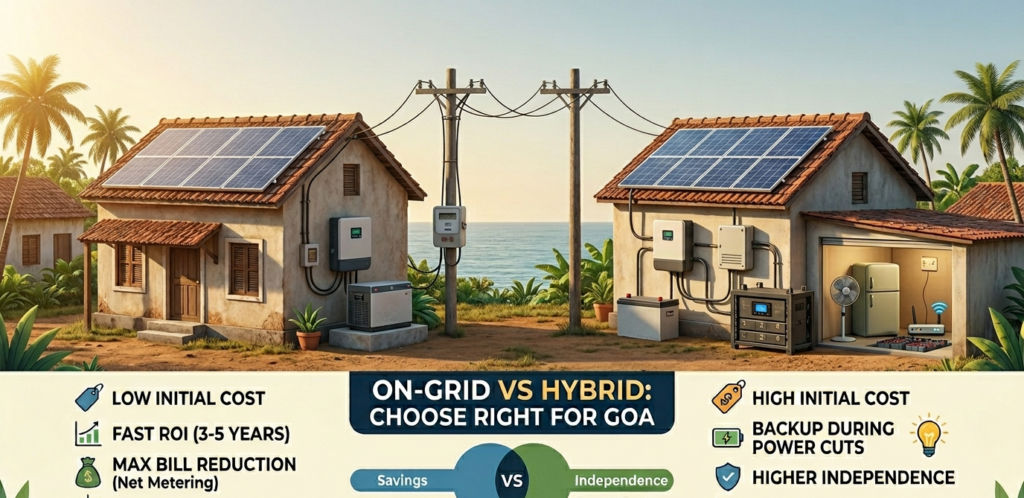
If you’re planning to install solar in Goa, one of the most important decisions you’ll face is choosing between an on-grid system and a hybrid solar system with battery.
At first glance, both options generate electricity and reduce your power bills. But the real question homeowners ask is: “Which one actually saves more money?”
The answer depends on your electricity usage, power cut frequency, and long-term goals. In this guide, we’ll break down costs, savings, ROI, and real-world use cases in Goa—so you can choose the right system for your home.
What is the cost difference between on-grid and hybrid?
The biggest difference between on-grid and hybrid solar systems comes down to battery storage.
An on-grid system is connected directly to the electricity grid. It does not store power. Any excess electricity is exported to the grid through net metering.
A hybrid system, on the other hand, includes a battery backup. It stores extra solar energy so you can use it during power cuts or at night.
Cost comparison in Goa (2026)
For a typical 3 kW residential system:
- On-grid system: ₹1.8 lakh – ₹2.2 lakh
- Hybrid system: ₹3 lakh – ₹4.5 lakh
The price difference is primarily due to:
- Battery cost
- Hybrid inverter cost
- Additional installation components
A hybrid system can cost 50–100% more than an on-grid system.
Which system gives better bill savings and ROI?
When it comes to pure financial savings, on-grid systems usually win.
On-grid solar savings in Goa
With net metering, excess electricity is sent back to the grid. This allows you to:
- Offset your electricity bills
- Reduce monthly costs significantly
- Achieve faster payback (typically 3–5 years)
Since there’s no battery involved, the initial investment is lower, and ROI is quicker.
Hybrid solar savings in Goa
Hybrid systems also reduce electricity bills, but:
- Battery adds significant upfront cost
- Stored energy replaces grid usage at night
- Limited export compared to on-grid
While you still save on bills, the payback period is longer (5–8 years).
ROI comparison
- On-grid → Faster ROI, higher financial efficiency
- Hybrid → Slower ROI, but adds backup reliability
If your goal is maximum savings, on-grid is the better option.
If your goal includes backup during power cuts, hybrid becomes valuable.
Best choice for homes in Goa
Choosing between on-grid and hybrid depends on your lifestyle and electricity needs.
On-grid is ideal if:
- You have minimal or rare power cuts
- Your priority is saving money
- You want faster return on investment
- You are comfortable relying on grid supply
This is why most urban homes in Goa prefer on-grid systems.
Hybrid is ideal if:
- You face frequent power cuts
- You need backup for appliances (fans, lights, WiFi, fridge)
- You want energy independence
- You are willing to invest more upfront
Hybrid systems are more common in:
- Villas
- Remote locations
- Homes with unstable power supply
When a battery is worth paying for
This is the most important question for many homeowners:
Is the extra cost of a battery really worth it?
A battery makes sense when:
You experience regular power cuts that disrupt daily life. In such cases, having backup power adds real value beyond just savings.
It is also useful if you rely heavily on electricity at night, when solar panels are not generating power. A battery allows you to use stored solar energy instead of grid electricity.
Additionally, if you want a degree of independence from the grid or simply peace of mind during outages, a hybrid system becomes a practical choice.
A battery may not be worth it when:
If your area has stable electricity supply, the battery may remain underutilized. In such cases, the extra cost does not translate into proportional savings.
For most city homes in Goa, where power cuts are infrequent, investing in a larger on-grid system often delivers better financial returns.
Why Solar De Goa helps you choose the right system
Choosing between on-grid and hybrid isn’t just a technical decision—it’s a financial one. That’s where Solar De Goa adds real value.
Personalized system recommendation
Instead of pushing a standard solution, Solar De Goa evaluates:
- Your electricity usage
- Power cut frequency
- Budget and savings goals
Accurate savings and ROI guidance
They provide clear insights on:
- Bill savings
- Payback period
- Long-term performance
End-to-end installation and subsidy support
Solar De Goa manages:
- System design
- Installation
- Net metering
- Subsidy process (for on-grid systems)
Reliable after-sales support
Whether you choose on-grid or hybrid, ongoing support is essential. Solar De Goa ensures:
- Quick service response
- Performance monitoring guidance
- Long-term system reliability
Final thoughts
When comparing on-grid vs hybrid solar in Goa, the decision ultimately comes down to your priorities.
If your goal is to maximize savings and achieve faster ROI, an on-grid system is the clear winner. It is cost-effective, efficient, and ideal for most urban homes.
However, if you value backup power and independence from outages, a hybrid system offers added reliability—at a higher cost.
The smartest approach is not to blindly choose one over the other, but to evaluate your specific needs.
With the right guidance from a trusted partner like Solar De Goa, you can confidently invest in a solar solution that delivers both financial and practical benefits.
FAQs
1. Which is better: on-grid or hybrid solar in Goa?
On-grid is better for savings and ROI, while hybrid is better if you need backup during power cuts.
2. Is a hybrid solar system worth it in Goa?
It depends on power cut frequency. If outages are frequent, hybrid systems can be worth the investment.
3. How much more expensive is hybrid solar?
Hybrid systems can cost 50–100% more than on-grid systems due to battery and inverter costs.
4. Can I add a battery later to an on-grid system?
Yes, but it may require upgrading to a hybrid inverter and additional modifications.
5. Do both systems qualify for subsidy?
Currently, subsidies are mainly available for on-grid residential systems under government schemes.